Best Rooftop AC Unit for Food Truck: Top 5 EPA-Approved Rooftop Models for Mobile Kitchens
Finding a rooftop air conditioner that keeps a food truck comfortable without draining your power supply can be challenging. This guide highlights five highly regarded models well-suited for mobile kitchens, off-grid setups, and compact spaces. Each selection emphasizes efficiency, quiet operation, and easy installation to help ensure consistent cooling during busy service days.
Summary table of selected products
| Product | Brand | BTU | Key Benefit |
|---|---|---|---|
| Countrymod 12V DC RV Air Conditioner 10000 BTU | countrymod | 10000 | Inverter design, energy-efficient, ultra-quiet |
| RecPro RV Air Conditioner 15K Ducted or Non-Ducted | RecPro | 15000 | Low amp draw, durable construction, quiet |
| 12V RV Air Conditioner, 10,000 BTU | outequip | 10000 | Fast cooling, built-in heat pump, energy efficient |
| RecPro RV Air Conditioner 15K Ducted or Non-Ducted (Non-Ducted) | RecPro | 15000 | Energy-efficient, quiet, rugged |
| FOGATTI InstaCool 13500BTU RV Air Conditioner | FOGATTI | 13500 | Dual compressors, fast cooling, eco-friendly refrigerant |
Countrymod 10,000 BTU 12V DC RV Air Conditioner

The Countrymod 12V DC RV Air Conditioner provides 10,000 BTU of cooling with inverter-driven operation. Its variable frequency design adjusts compressor speed to meet demand, helping manage temperature with energy efficiency in mind. The unit is designed for non-ducted rooftop installation and is suitable for RVs, trailers, fifth wheels, and food trucks. Users can expect reduced energy consumption—approximately 0.3 kWh per hour—alongside a reported battery life of up to 10 hours in some configurations. Noise levels are typically in the 45–55 decibel range, offering a quieter experience than many traditional rooftop units.
Key features include inverter design for on-demand cooling, relatively low noise output, and even air distribution to avoid direct air-blast discomfort. This model emphasizes compatibility with off-grid or solar setups while maintaining compact form for mobile kitchens.
RecPro RV Air Conditioner 15K Ducted or Non-Ducted

RecPro’s 15,000 BTU unit is designed for versatility in RVs and food trucks, offering both ducted and non-ducted configurations. It emphasizes low amp draw to support off-grid, solar, or generator-based setups, reducing overall energy consumption while delivering robust cooling power. The unit features UV-resistant plastics and an aerodynamic exterior for long-lasting rooftop performance. Noise levels are engineered for quiet operation, with a claimed 55.4 dB, making it conducive to nighttime rest and daytime work without intrusive hums.
Benefits include efficient power usage, durable build, and compatibility with a range of RV layouts. The installation is described as straightforward, though professional setup is advised for optimal safety and performance in non-ducted arrangements.
12V RV Air Conditioner, 10,000 BTU Non-Ducted

The outequip 12V DC inverter-based unit delivers 10,000 BTU of cooling with a built-in heating option via a 4,500 BTU PTC heater. It targets compact spaces like food trucks, campers, and trailers, offering strong airflow (up to 450 m³/h) for rapid temperature reduction. The 12V inverter design helps minimize battery drain, aligning with solar or off-grid setups. The heating function provides supplemental warmth for shoulder seasons, contributing to year-round usability in mobile kitchens.
This model emphasizes fast cooling, safe auxiliary heating, and energy-conscious operation. It is suited for operators who need reliable cooling during busy shifts while keeping electrical load within manageable limits.
RecPro RV Air Conditioner 15K Ducted or Non-Ducted (Non-Ducted)

RecPro’s non-ducted variant of the 15,000 BTU system continues the brand’s focus on efficiency and quiet operation. It combines low amp draw with a rugged exterior and UV-resistant plastic to withstand road travel and exposed rooftop conditions. The unit’s 55.4 dB operation aligns with a calm interior environment for both staff and customers, while its compact design helps preserve RV aerodynamics and rooftop space.
Key considerations include installation method (non-ducted) and how the unit integrates with existing RV ceiling configurations. The system aims to balance powerful cooling with energy-conscious operation suitable for food trucks that rely on portable power or solar arrays.
FOGATTI InstaCool 13500BTU RV Air Conditioner
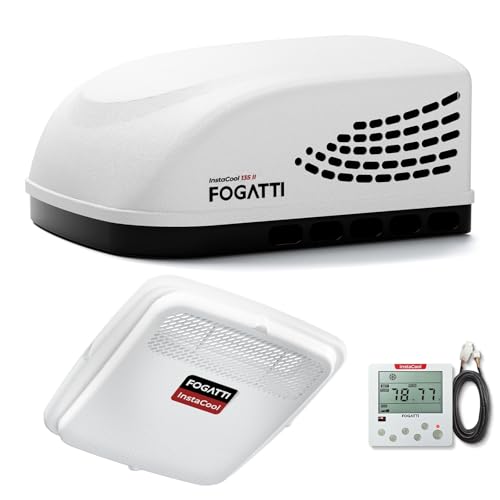
FOGATTI’s InstaCool 13,500 BTU rooftop unit emphasizes rapid cooling with dual high-efficiency compressors and the eco-friendly R32 refrigerant. The all-in-one design aims for simpler installation and year-round performance, balancing cooling power with energy efficiency. Operators may appreciate the faster chill in warm climates, which can help maintain safe temperatures in food preparation areas and display zones. The unit requires access to both 115V AC power and 12V DC power, a consideration for power planning on smaller rigs or those relying on solar arrays.
TOSOT 16000 BTU GO Cool RV Air Conditioner

The TOSOT Go Cool unit offers a large 16,000 BTU cooling capacity with 12,500 BTU heating, suitable for RVs up to 600 square feet. It features smart WiFi control via the Gree+ app for remote management, which can be beneficial for food trucks that require flexible temperature management across shifts. The unit is designed to operate across a wide temperature range (indoor 61°F – 86°F; outdoor up to 115°F) to accommodate diverse climates. It is compatible with larger RV layouts, advancing comfort when a mobile kitchen sees fluctuating crowd sizes and external heat loads.
BZW RV Air Conditioner 15,000 BTU (Non-Ducted, White)

The BZW 15,000 BTU non-ducted RV air conditioner delivers reliable cooling within a standard 110–120V electrical setup. It emphasizes ease of installation with a non-ducted design and includes wireless remote control for convenient operation. The unit supports flexible climate control, including cooling, dry, fan, sleep, and timer modes. It is designed to fit typical rooftop vent dimensions and aims to simplify retrofits for food trucks transitioning from older rooftop units.
Buying Guide: Key Purchase Considerations For Food Trucks
- Power compatibility and efficiency: Food trucks often rely on generator power or solar systems. Look for units with inverter technology, low amp draws, and energy-efficient operation to maximize uptime between service calls.
- Cooling capacity and space: BTU requirements depend on the kitchen size, cargo area, and local climate. Consider a unit with sufficient BTU for peak afternoon heat while ensuring rooftop access and clearance are not compromised.
- Noise levels: Quiet operation is crucial in customer-facing environments and for staff comfort. Target units with around 45–55 dB to minimize disruption during service.
- Installation options: Non-ducted vs. ducted setups affect installation complexity and compatibility with existing RV or truck configurations. Non-ducted units may be simpler to retrofit in tight spaces.
- Heating capability: If you operate in shoulder seasons, a heat pump or built-in heating can extend use without a separate heater.
- Durability and weather resistance: The rooftop unit should withstand road vibrations, wind, rain, and sun exposure. UV-resistant materials and rugged housings are beneficial for long-term use.
- Remote monitoring and smart control: WiFi or app-based controls offer convenience for adjusting temperatures during prep or service hours without manual interaction.
- Installation and maintenance: Ensure that installation is feasible with your trailer or truck roof, and verify service support and availability of replacement parts in your area.
- Vehicle electrical integration: Confirm compatibility with your electrical system, including inverters and battery bank, to avoid overloading circuits during peak demand.
When choosing a rooftop AC for a food truck, balance cooling needs against power constraints, climate considerations, and your workflow. The selections above provide a range of BTU capacities, power configurations (12V DC, 110–120V AC), and design approaches (ducted vs non-ducted) to fit common mobile kitchen setups. Always verify installation requirements and warranty terms with the supplier before purchasing.