Best Rubbing Compound for Deep Scratches: Restore Paint Clarity and Shine
Rubbing compounds are essential tools for repairing deep scratches and restoring gloss on vehicle paint. This article highlights proven options, explains how they work, and compares top choices to help you choose the right product for DIY detailing and professional use alike.
Summary of selected products (quick reference):
| Product | Brand | Key Benefit |
|---|---|---|
| Meguiar’s Ultimate Compound | Meguiar’s | Removes swirls and defects; showroom shine |
| Meguiar’s Mirror Glaze M105 Ultra-Cut Compound | Meguiar’s | Heavy defect removal; high gloss finish |
| No.7 Heavy Duty Rubbing Compound | No.7 | Deep cleaning of dull finishes; restoration |
| menzerna Heavy Cut Compound 1000 | menzerna | Powerful cut with smooth finish |
| 3D One Car Scratch & Swirl Remover | 3D | One-step paint correction and gloss boost |
Below are five carefully chosen products, each with a distinct approach to deep scratch correction, so readers can compare cutting power, finish quality, and ease of use for their specific needs.
Meguiar’s Ultimate Compound
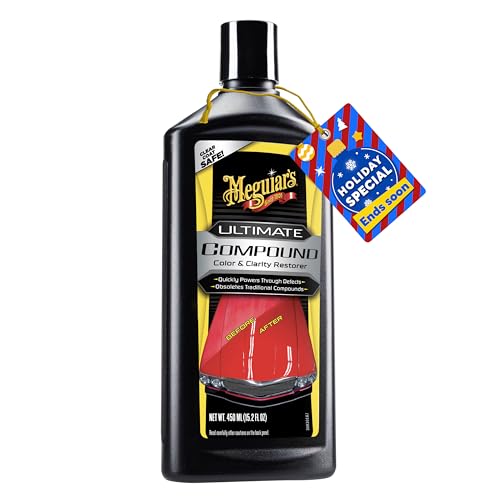
Meguiar’s Ultimate Compound removes scratches, swirls, and oxidation to restore color and clarity, delivering a showroom shine in minutes. The formula is safe for clear coats and gloss paints, making it suitable for DIY detailers and professionals alike. It can be used by hand or with a polisher, offering a flexible approach to paint correction.
Meguiar’s Mirror Glaze M105 Ultra-Cut Compound

Meguiar’s M105 Ultra-Cut is designed for heavy defect removal, capable of addressing deep scratches, oxidation, and sanding marks while maintaining a high-gloss finish. It works well for severe paint flaws and is compatible with soft to medium-hard paints when used with proper polishing gear. The micro-abrasives help minimize further swirling for a refined outcome.
No.7 Heavy Duty Rubbing Compound

No.7 Heavy Duty Rubbing Compound offers robust cleaning of dull finishes and scratches, with a focus on restoring surface brightness. Its American-made formulation supports heavy-cutting action suitable for older or oxidized finishes, and it blends well with hand or machine polishing workflows.
menzerna Heavy Cut Compound 1000

Menzerna Heavy Cut Compound 1000 provides powerful cutting action to remove deep scratches and swirl marks, while offering a smooth, refined finish. This silicone-free formula is compatible with standard polishing setups and can be used with orbital or rotary machines as well as by hand for targeted spot correction.
3D One Car Scratch & Swirl Remover 16oz

3D One blends cutting and finishing polishing in a single step to correct swirls, scratches, and oxidation. It aims to deliver true paint correction with minimal dust and is versatile for hand use or with a DA polisher, suitable for daily drivers to show cars seeking a mirror-like gloss.
Buying Guide
When selecting a rubbing compound for deep scratches, consider these factors to match your vehicle, finish, and tools:
- Scratch depth and paint type: Heavier defects may require a more aggressive compound (e.g., M105 or heavy-cut formulas) before finishing with a fine polish.
- Cutting power vs. finish quality: Balance the level of compound aggressiveness with the desired final gloss to avoid burn-through on soft paints.
- Application method: Hand application is suitable for small areas; machine polishing (rotary or dual-action) accelerates correction on large panels.
- Foam pad compatibility: Use appropriate pads (cutting, finishing, or all-in-one) to optimize defect removal and minimize hazing.
- Dust and cleanup: Zero-dust or low-dust formulas reduce cleanup time and help keep surrounding areas clean during polishing.
- Surface prep: Clean and dry the surface before applying compounds; wipe-off residues promptly to inspect correction progress.
- Safety and compatibility: Verify that the product is safe for your clear coat, paint type, and any existing coatings or sealants.
For best results, follow step-by-step application guidance: start with a test spot, use the appropriate pad and speed, work in controlled passes, and frequently wipe to assess progress. After achieving the desired correction, finish with a dedicated polish or sealant to protect the restored surface.