Best RV Propane Generator Options for Quiet, Reliable Power on the Road
Finding the right RV propane generator means balancing portability, noise, run time, and clean power for sensitive devices. The following five models are among the top choices for American campers who need dependable dual-fuel or propane-ready inverter generators designed for RV use. Each option emphasizes quiet operation, safety features, and compatibility with RV electrical needs to keep everything from lights to laptops powered during trips.
Summary Table of Selected Products
| Product | Brand | Fuel Type | Key Feature | Approx. Power Output |
|---|---|---|---|---|
| WEN DF360iX | WEN | Gasoline / Propane | Low-noise inverter, CO Watchdog | 3600 surge / 2900 running (gas) • 3500 surge / 2600 running (propane) |
| WEN DF680iX | WEN | Gasoline / Propane | Electric start, CO Watchdog, EV backup capable | 6800 surge / 5100 running (gas) • 6000 surge / 4500 running (propane) |
| PowerSmart 3800 | PowerSmart | Gasoline / Propane | Dual fuel, CO Protect, RV-ready outlet | 3800 starting / 3300 running (gas) • 3500 starting / 3100 running (propane) |
| Westinghouse 4000 Peak | Westinghouse | Gas / Propane | Remote start, dual outlets, CO sensor | 4000 peak / 3300 running (gas) |
| Westinghouse 2550 | Westinghouse | Gas / Propane | Lightweight, economy mode, RV-ready | 2550 peak / 1900 running (gas) |
WEN DF360iX: Quiet Dual-Fuel RV-Ready Inverter

The WEN DF360iX delivers dual-fuel versatility in a compact, RV-friendly inverter. With gasoline support delivering 3600 surge watts and 2900 running watts, and propane support with 3500 surge and 2600 running watts, it covers common RV loads while remaining portable. The unit is designed for quiet operation and uses a fuel shutoff and CO watchdog to safeguard users and equipment. It outputs clean power suitable for smartphones, tablets, and laptops, helping prevent sensitive electronics from voltage irregularities.
Key considerations for this model include its dual-fuel capability, making it suitable for trips where fuel availability varies. The inverter design helps keep electrical noise low and power stable, which is beneficial for RV appliances such as microwaves, fridge components, and entertainment systems. The DF360iX is a practical choice for weekend trips or longer ventures where noise reduction and electronics safety matter.
WEN DF680iX: Higher Output, RV-Ready Inverter

The DF680iX increases power to accommodate larger RV setups or higher electrical demand. It runs on both gasoline (6800 surge / 5100 running watts) and propane (6000 surge / 4500 running watts). A bonded-neutral 240V configuration supports low-power Level 2 charging for battery and hybrid vehicles, making it a practical option for RV travelers with electric vehicle compatibility. The CO watchdog sensor adds a safety layer by automatically stopping the generator if dangerous carbon monoxide levels are detected, helping to protect occupants in enclosed RV spaces.
When evaluating the DF680iX, consider your typical travel load and whether you’ll need more continuous power or occasional peak capacity. The electric-start feature reduces manual effort, especially after long drives, and the CO shutdown helps meet safety expectations for enclosed living spaces while on the road.
PowerSmart 3800: Dual Fuel With RV-Ready Convenience
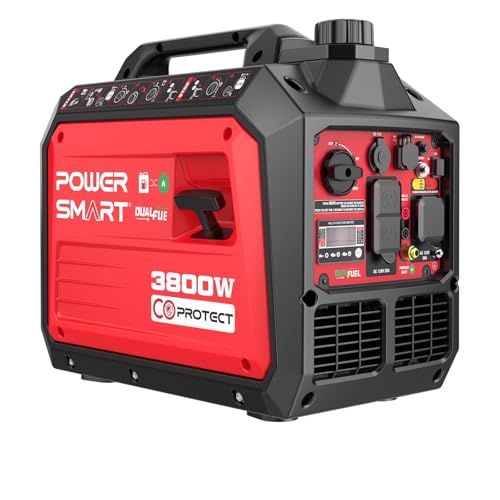
The PowerSmart 3800 inverter generator offers dual-fuel flexibility with a practical RV setup. Gasoline support provides 3300 running watts, while propane delivers 3100 running watts. A 30A RV outlet makes it straightforward to connect to standard coaches, and the unit’s CO Protect feature adds an automatic shutdown in unsafe CO conditions. Notably, PowerSmart emphasizes runtime—up to 4.5 hours at 50% load—and relatively quiet operation with decibel levels published at 59 dBA from a distance of 23 feet at 25% load, which is beneficial for campground etiquette and neighbor considerations.
For campers who value simple operation and dependable RV compatibility, the 3800 model offers a balanced mix of power, portability, and safety features, alongside a price point aimed at light-to-moderate camping use.
Westinghouse 4000 Peak: Remote Start Dual Fuel Inverter

The Westinghouse 4000 Peak offers a versatile dual-fuel platform with remote electric start, a clearly labeled display, and multiple outlets including RV-ready TT-30R 30A. Its 4000 peak watts and 3300 running watts on gas provide solid capacity for RV essentials and household devices, while the propane setting improves fuel availability on longer trips. The CO sensor and automatic shutdown add safety when used in enclosed spaces such as RV interiors. The model is designed with convenience in mind, featuring a tilting or telescoping handle for easier transport and a digital display showing fuel level and run-time metrics to help plan outages and refueling intervals.
Users should weigh the convenience of remote start against the weight and power needs of their RV. This Westinghouse option balances portability with a strong feature set for camping, tailgating, or emergency backup scenarios.
Westinghouse 2550: Lightweight RV-Ready Inverter

The Westinghouse 2550 combines compact weight with RV-ready capability and multiple outlets, including a dedicated RV outlet and standard 120V duplex ports. With 2550 peak watts and 1900 running watts on gas, it suits lighter RV loads and essential devices. Propane operation provides extended run times where fuel is the preferred option. The unit emphasizes low noise and fuel efficiency, with an economy mode designed to reduce fuel consumption and provide longer runtimes on small tanks. A CO sensor further adds essential safety for RV use in enclosed spaces.
For travelers prioritizing portability and quiet operation, the 2550 offers a compact alternative with credible power reserves for basic RV needs like lighting, charging devices, and a small fridge or fan.
WEN DF480iX: Higher-Output Quiet RV Inverter

The DF480iX expands to 4800 surge watts and 4000 running watts on gasoline, with propane support also offering 4320 surge and 4000 running watts. As with other WEN models, it emphasizes quiet operation and clean power suitable for electronics. This generator targets RV users who need robust power for air conditioning, microwaves, and other energy-intensive loads during camping or temporary off-grid setups. Inverter technology keeps voltage stability and reduces harmonic distortion, preserving device longevity while reducing noise.
When evaluating this model, consider the consistency of output during longer runs and the ease of starting in varied weather conditions. The 4800-watt class accommodates moderate RV living demands and can serve as a core power source for extended trips.
Champion 4000-Watt Dual Fuel: Quiet Technology With CO Shield

Champion’s 4000-watt inverter is designed for the RV lifestyle with dual-fuel capability and a CO Shield system that auto-shuts off on CO detection. It delivers 4000 starting watts and 3000 running watts on gasoline, with extended runtimes up to about 10 hours under nominal loads, and 2700 running watts with up to 25 hours on propane. Quiet operation at 64 dBA from 23 feet makes this model suitable for campground use. The optional parallel kit, sold separately, allows linking with other Champion inverters or power stations for more power and longer runtimes, which is helpful for larger rigs or weekends with heavy electrical use.
Consider the likelihood of parallel operation and the compatibility with other Champion or Power Station equipment when planning longer trips or more demanding electrical setups.
Westinghouse 4650 Peak: Dual Fuel, RV-Ready Power
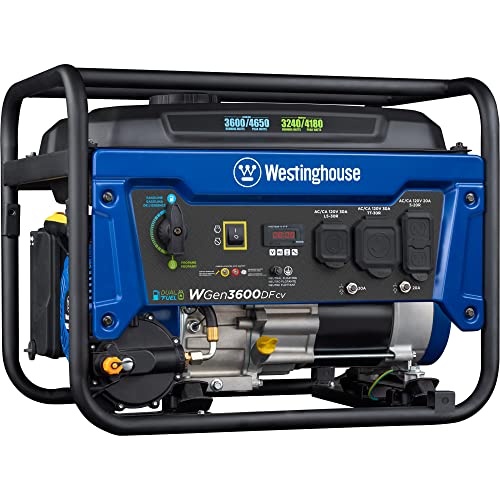
The Westinghouse 4650 Peak Watt dual fuel generator is designed for RV users needing robust power, with a 4.0-gallon fuel capacity and up to 14 hours of operation per tank. It provides one 5-20R 120V outlet, an RV-ready TT-30R 30A outlet, and a L5-30R 30A outlet, all with rubber outlet covers for safety. The CO sensor adds automatic shutdown for safety. This model targets campers who require reliable, multiple-outlet access on the go, including running a small air conditioner, fridge, and lighting concurrently.
Assess your rig’s power profile — if you frequently run higher-wattage appliances along with RV conveniences, this model’s higher peak and multiple receptacles can be advantageous for a broader range of loads.
Buying Guide: Key Purchase Considerations for RV Propane Generators
Power needs: Match starting and running watts to your typical RV loads (air conditioner, heater, fridge, microwaves, chargers). Dual-fuel options offer flexibility when one fuel is scarce.
Safety features: Look for CO sensors/shutoff, low-oil shutdown, and automatic overload protection to protect both people and appliances in enclosed spaces.
Noise and runtime: Generator noise affects campground etiquette; inverter technology generally reduces noise and stabilizes output. Consider runtime on your expected fuel sources and tank sizes.
RV compatibility: Ensure the unit has an RV-specific outlet (TT-30R 30A) or adjustable configuration for your camper’s electrical system. Parallel capability can extend power in high-demand scenarios.
Portability and setup: Weigh the unit, check transport handles or wheels, and assess ease of starting (electric start versus recoil). Consider the level of maintenance required for dual-fuel engines.
Fuel availability and storage: Propane can be easier to store and transport, while gasoline typically offers broader fueling options. Plan for safe storage, especially in travel vehicles and near living spaces.
Maintenance and warranty: Review oil changes, spark plug service, air filters, and warranty terms. A reputable brand with good spare-part availability minimizes downtime on trips.
Environmental considerations: Some models advertise “clean power” suited for sensitive electronics, thanks to better voltage regulation and reduced harmonic distortion, which is important for modern devices.
Budget and value: Higher-output or feature-rich models cost more but may be justified for larger RVs or frequent use. Compare fuel economy, run time, and safety features to determine overall value.