Best Shocks for Off Road: Top Picks for Tough Terrain
Off-road adventures demand reliable dampers that can handle rough trails, big jumps, and variable terrain. The right shocks improve wheel travel, control, and overall ride comfort while maintaining stability at higher speeds. The following selections highlight a mix of heavy-duty performance and value, drawn from trusted brands in the off-road community. Each option balances heat dissipation, valving, and chassis compatibility to help you navigate rocks, mud, and sand with confidence.
Summary of selected products:
- Fox Offroad Shocks 883-26-098 Performance Elite Series 2.5 Reservoir Shock (Pair) – Adjustable
- Bilstein 5100 Monotube Gas Shock Set (Ford F-Series compatibility)
- Fox Offroad Shocks 985-02-146 Performance Series 2.0 Coil-Over IFP Shock
- TrendsAuto 5100 Series Rear Shocks for Toyota Tacoma TRD Off Road
- Rough Country 0-4″ N3 Rear Shock Absorbers (Chevy/GMC 1500)
Fox Offroad Shocks 883-26-098 Performance Elite Series 2.5 Reservoir Shock

Fox Racing Shox delivers a robust 2.5 reservoir shock with aggressive damping suitable for aggressive off-road builds. The 2.5″ impact-extruded and CNC-machined 6061-T6 aluminum body reduces unsprung mass while maintaining durability. A 7/8″ hard chrome-plated steel shaft provides strong resistance to dents and bending, while a redundant sealing pack system helps prevent fluid loss under extreme conditions. This setup is designed to handle high-speed desert runs and rock crawling with improved heat management and consistent performance over long rocky grades.
Key features support trail reliability: heat dissipation through aluminum construction, resilient shafts for harsh impacts, and a sealing system that preserves performance across variable temperatures. These considerations are essential for maintaining predictable damping during sustained off-road conditions. The shocks ship as a pair for symmetric suspension tuning and easier installation, helping you preserve vehicle balance on uneven terrain.
Bilstein 5100 Monotube Gas Shock Set For Ford F-Series
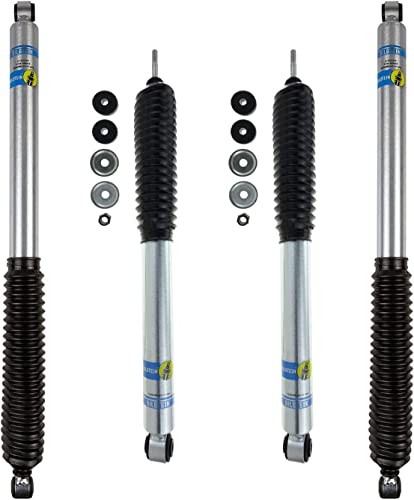
These Bilstein 5100 shocks use a monotube design that maintains fade-free performance under dusty, rocky, or wet conditions. The configuration is tuned for off-road reliability while still offering smooth on-road manners and affordability. A key benefit is reduced steering vibrations, as the dampers effectively counter tiny steering inputs that can become amplified on rough pavement. The design integrates a rugged mount and spring-perch compatibility, making it a practical choice for owners who want a straightforward upgrade with proven daily-driver stability.
Design implications: the monotube architecture promotes quicker heat dissipation and consistent damping characteristics as temperatures rise. These shocks pair well with common leveling kits and factory springs, enabling a balanced ride without major suspension rework. Ideal for mixed-use trucks and SUVs that frequently transition from highway to trail action, delivering dependable control during rock approaches and uneven washboard roads.
Fox Offroad Shocks 985-02-146 Performance Series 2.0 Coil-Over IFP Shock

This Fox Performance Series coil-over IFP shock targets vehicle-specific tuning and advanced heat management. The aluminum body dissipates heat faster than steel, helping maintain damping consistency on long, demanding runs. The internal floating piston (IFP) design separates oil from high-pressure nitrogen gas, minimizing aeration and ensuring stable dampening under abrupt terrain changes. This setup excels on stage rides and high-speed desert routes where precise wheel control matters for line selection and corner stability.
Installation considerations include compatibility with common coil-over configurations and the need for precise valving calibration. The coil-over design simplifies lift and ride-height adjustments, enabling more responsive off-road behavior, especially when the suspension is tasked with aggressive articulation or heavy loads. Expect strong resistance to fade and reliable dampening across varying temperatures and speeds.
TrendsAuto 5100 Rear Shocks For Toyota Tacoma TRD Off Road

TrendsAuto’s 5100 rear shocks feature monotube construction with digressive valving designed to adapt rapidly to changing road conditions. The 0-1″ rear lift compatibility makes them suitable for Tacoma TRD Off Road layouts seeking improved ride quality and handling without a full suspension overhaul. Their valving aims to deliver immediate response on rough surfaces, while maintaining comfort on paved roads. These shocks are tested for vehicle-specific performance to ensure predictable control across a range of terrains.
Notable considerations: the monotube design supports consistent damping as temperatures fluctuate, and the digressive valving helps balance lively off-road dynamics with stable highway behavior. The pairing of front and rear shocks in this category is often used to achieve a harmonious stance and improved wheel control when traversing rutted trails or uneven gravel roads.
Rough Country 0-4″ N3 Rear Shocks For Chevy/GMC 1500

Rough Country’s 0-4″ N3 rear shocks feature 10-stage variable valving and nitrogen charging to handle a range of load conditions. The shocks use rubber bushings and a robust 36kN tensile strength steel body with a fast-cooling 54mm design to manage heat during extended off-road sessions. This configuration supports performance gains on lifted rigs or trucks with mild rear lift, aiming to improve ride quality, handling, and comfort on rough trails while preserving highway manners.
Considerations include valve range and heat management under sustained off-road runs, as well as compatibility with your lift amount and tire setup. For users who want an affordable yet capable rear shock option, these can be paired with compatible front shock upgrades for balanced handling across mixed terrains.
Rough Country 4.5-8″ N3 Rear Shocks For Chevy/GMC 1500
This Rough Country option targets larger lift applications with 4.5-8″ rear shock travel. Similar to the 0-4″ variant, it uses 10-stage valving and nitrogen charging to deliver stable handling on uneven terrain, with an emphasis on maintaining control during high-speed off-road travel and when landing after jumps. The added travel helps with larger wheel articulation, improving grip on rocks and rutty surfaces while preserving ride quality on-road during daily use.
For prospective buyers, it’s important to match the rear shocks with a compatible front set and verify the overall suspension geometry. Consider the intended use—daily driving versus dedicated off-road expeditions—and align the shock tuning with your vehicle weight, tire size, and lift height.
Buying Guide: Key Considerations For Off-Road Shocks
When choosing off-road shocks, home in on dampening control, heat management, and compatibility with your vehicle’s suspension geometry. Monotube designs offer better heat dissipation and fade resistance for longer trail runs, while twin-tube options can deliver a smoother street ride. Valving choices—whether fixed, adjustable, or digressive—determine how the shock reacts to rough terrain and changing speeds. Firm criteria include vehicle weight, lift height, tire size, and intended terrain.
- Vehicle compatibility: Ensure the shocks fit your make, model, and any lift kit or leveling adjustments. Check spring rates, mounting points, and available perch options.
- Valving and damping: Adjustable or digressive valving provides tunability for various terrains. Consider shocks with heat-dissipating bodies (like aluminum) for better long-term performance.
- Durability and seals: Look for high-quality shafts, seals, and corrosion resistance, especially if you frequently expose components to dust, water, and mud.
- Ride quality vs. off-road performance: Decide whether you prioritize daily driving comfort or maximum articulation and control on trails. Some shocks skew toward mixed-use performance, others toward extreme off-road capability.
- Maintenance and serviceability: Check availability of rebuild kits and whether re-valving or service is straightforward for ongoing use.
Other perspectives to consider include the benefits of coil-overs for faster ride-height changes, the importance of heat management in high-speed desert runs, and the trade-offs between monotube and twin-tube architectures. Matching front and rear suspension components can yield a more balanced handling profile, reducing body roll and improving steering accuracy when negotiating tight switchbacks or rough washboard.