Best Solar Car Kits for Classroom Learning and Hands-on STEM
Solar car kits offer engaging, hands-on ways to teach students about energy, motion, and engineering. This article highlights five top solar car kits suited for classrooms, clubs, or science fairs. Each option supports group activities, aligns with STEM curricula, and uses real solar power to demonstrate energy conversion. Below is a quick reference table of the chosen products to help educators compare at a glance.
| Product | Brand | Best For |
|---|---|---|
| 10-Pack Solar-Powered Car Kits | STEM Inventions | Cohesive classroom kits for group projects |
| 4 in 1 Solar Power & Electric Motor STEM Kits | CYOEST | Mixed-model exploration and family STEM nights |
| STEM Kit – 3 DIY Car Projects | STEM Inventions | Curriculum units on energy and motion |
| Sntieecr Electric Circuit Motor Kit | Sntieecr | Comprehensive circuit and motor projects |
| STEM Solar Power Car Kit with Remote Control | ZOVRION | Remote-controlled solar car activities |
These selections emphasize safe, student-friendly assembly, clear learning outcomes, and durable components suitable for classroom use. Each kit supports inquiry-based learning, problem-solving, and collaboration, helping students connect theory to real-world sustainable technology.
10-Pack Solar Car Kits For Classrooms

This kit delivers a bulk option ideal for large classrooms or science clubs. Each car is powered by a genuine solar cell that activates with direct sunlight, enabling authentic demonstrations of energy conversion. The set includes ten individual kits, designed for ages 8 to 14, making it easy to group students into teams. Assembly requires no glue or soldering, supporting quick setup and minimal mess in classroom environments. The variety fosters collaboration, as students compare solar performance and iterate designs to optimize speed or stability.
4 in 1 Solar Power & Electric Motor STEM Kits

This set combines four project options: a solar car, a solar-powered fan, a wind-powered car, and a wooden plane. Each model is packaged separately, including a magnetized screwdriver and illustrated instructions for straightforward assembly. The kit supports classroom STEM projects, family STEM activities, and presents a cohesive way to explore energy, motion, and engineering concepts. Its gift-ready packaging makes it suitable for science fairs and classroom displays that encourage student presentation skills while learning.
STEM Kit – 3 DIY Car Projects

Designed for classroom use, this 3-in-1 kit includes a solar-powered car, a mousetrap car, and a rubber band car. Students explore solar energy, kinetic energy, and propulsion, linking practical builds to physics concepts. The set aligns with educational standards and requires no special tools, enabling quick, frustration-free builds. Suitable for in-class demonstrations, STEM clubs, or homeschool groups, it supports iterative testing as students compare performance across different propulsion systems.
Sntieecr Solar Panel Electric Circuit Kit

This value-packed kit offers an extensive assortment of components for a wide range of experiments. It includes a solar panel, motors, wheels, LEDs, switches, wires, gears, and more, enabling multiple projects that span basic circuits to more complex electromechanical systems. The kit supports Montessori-style exploration and classroom science stations, encouraging students to design, test, and refine electrical circuits while learning about energy flow and circuit basics.
STEM Solar Power Car Kit With Remote Control
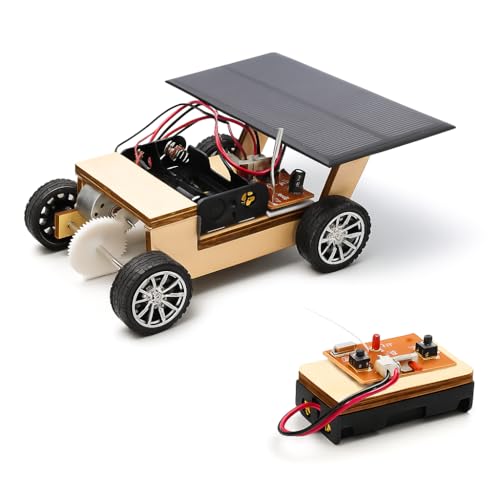
Targeted toward ages 8–12, this solar car kit combines hands-on solar energy learning with remote control play. It supports three power modes: solar, battery, and hybrid, enabling students to compare energy use and efficiency. The remote control offers a long range for indoor and outdoor exploration, making it suitable for classroom demonstrations, science fairs, and extension projects. The kit emphasizes renewable energy concepts and practical engineering design while remaining accessible for younger students.
DIY RC Car Kit – Solar & Remote

This kit features two play styles: a wireless remote-controlled car and a solar-powered car, enabling students to explore both RC technology and solar energy in one compact package. Assembly introduces circuit diagrams, solar panels, and propulsion systems, helping students understand how energy is converted and controlled. Its dual-mode design is well-suited for classroom demonstrations, science fairs, and independent study projects that encourage curiosity and persistence in problem-solving.
4M Green Science Solar Rover
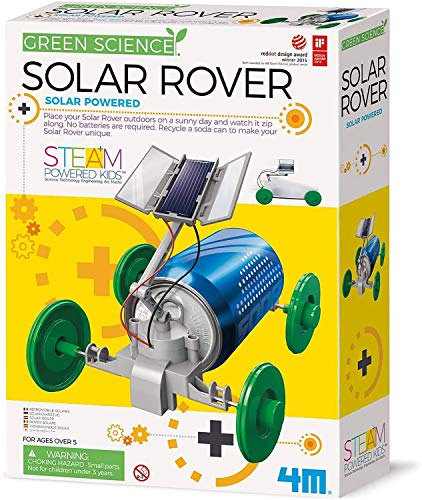
Designed for younger learners (ages 5+), this kit emphasizes solar energy basics and STEAM exploration. It provides all the parts to build a solar-powered rover and introduces energy conversion concepts in a simple, engaging way. The project supports foundational science literacy, collaborative play, and early engineering thinking, making it a strong entry point for elementary classrooms experimenting with solar technology.
STEM Building Toys: Solar Car Sets

This set features four STEM kits including a solar car, solar fan, wind-powered car, and wooden plane. Individually packaged for easy distribution, they support family STEM activities and classroom projects. The comprehensive packaging makes it easy to align activities with standards, and the multiple models allow teachers to rotate stations, enabling students to compare how different energy systems perform under similar conditions.
Buying Guide: Key Purchase Considerations for Classroom Solar Car Kits
- Learning objectives: Choose kits that clearly align with energy, motion, and engineering standards. Look for kits that explain concepts like energy conversion, friction, and propulsion.
- Group capacity: For classrooms larger than 20 students, opt for bulk sets or multiple kits that support team-based learning and rotation through stations.
- Ease of assembly: Prefer kits with simple parts, clear illustrated instructions, and no required tools or soldering to minimize setup time.
- Durability and safety: Check for robust plastic components and non-hazardous materials suitable for classroom use and outdoor demonstrations.
- Teaching supports: Consider kits that include teacher guides, rubrics, or align with science fair project ideas to maximize instructional value.
- Power modes and flexibility: Models offering solar, battery, or hybrid options help illustrate energy choices and efficiency under different conditions.
- Assessment potential: Look for kits that provide measurable outcomes, such as speed comparisons, distance tests, or energy efficiency metrics.
- Storage and organization: Systems with clearly labeled parts and storage containers facilitate quick setup and tidy classrooms.
Educators can mix and match these kits to create a modular STEM program that scales from single-day demonstrations to multi-week energy projects. By emphasizing hands-on inquiry, students develop critical thinking and collaboration skills while gaining practical insight into renewable energy concepts.