Best Solar Charge Controllers for RVs: Top Picks for Off-Grid Power
Finding the right solar charge controller for an RV setup ensures safe battery charging, efficient energy use, and long battery life on the road. The following selections focus on reliability, RV-friendly features, and compatibility with common battery chemistries like AGM, Gel, Flooded, and Lithium. Each entry includes a concise look at performance, protection features, and ease of use to help you compare options for your RV solar system.
| Product | Brand | Battery Types | Key Benefit |
|---|---|---|---|
| Adventurer 30A | Renogy | AGM, Gel, Flooded, Lithium | Solid PWM option with LCD and negative-ground design |
| Rover 20A MPPT | Renogy | Gel, Flooded, Lithium | Advanced MPPT with high efficiency for RV systems |
| Wanderer 10A | Renogy | AGM, Gel, Flooded, Lithium | Compact, flexible RV-friendly controller |
| Victron SmartSolar MPPT 50A | Victron Energy | 12V/24V systems (various chemistries) | Bluetooth monitoring, synchronized charging across units |
| SOLPERK 8A PWM | SOLPERK | Lead-Acid, LiFePO4 | Double-check protection features and rugged build for outdoors |
Renogy Adventurer 30A PWM Solar Charge Controller

The Adventurer 30A PWM controller from Renogy is designed for seamless RV integration with a negative-ground design for safer grounding of the solar panel charger, battery bank, and loads. It automatically detects 12V and 24V systems and supports sealed, gel, flooded, and lithium batteries. Its 4-stage charging includes Bulk, Boost, Float, and Equalization, helping to extend battery life—particularly useful for RV setups where lithium batteries may be used. The LCD provides clear status information, and the kit-friendly flush mount design aids in clean interior installations.
Key features include a compact size, real-time monitoring via LCD, and a design that emphasizes safety with negative-ground compatibility. Built to support RV and marine environments, this controller balances performance with straightforward operation, making it a reliable entry-point choice for RV solar systems.
Renogy Rover 20A MPPT Solar Charge Controller

The Rover 20A MPPT controller from Renogy delivers high efficiency and precise charging for demanding RV solar installations. It supports 12V and 24V systems and is compatible with lead-acid, AGM, gel, flooded, and lithium batteries. The MPPT technology ensures maximum power extraction from solar panels, even under partial shading or variable sun conditions, helping RV owners get the most from their rooftop or portable panels. It includes robust protections and a user-friendly LCD interface to monitor charging stages, voltages, and current flow.
Designed for versatility in RV and marine applications, the Rover 20A is a strong choice when you want more efficient energy conversion and reliable battery maintenance for longer trips off-grid. Its weather-tolerant build and auto-detecting voltage simplify setup while offering the flexibility to expand your solar array in the future.
Renogy Wanderer 10A PWM Solar Charge Controller
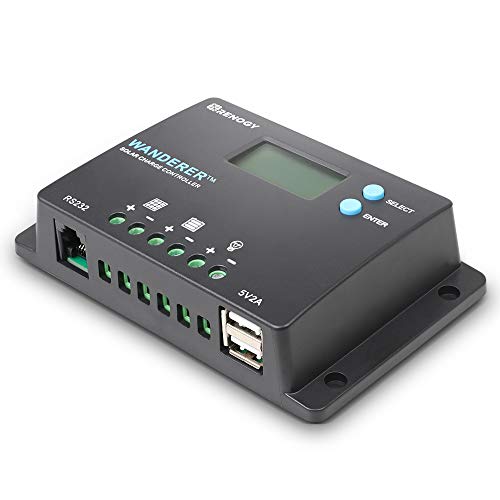
The Wanderer 10A controller by Renogy is a compact PWM solution ideal for RVs with tighter space. It supports 12V/24V systems and multiple battery chemistries, including AGM, Gel, Flooded, and Lithium. The 4-stage charging profile—Bulk, Boost, Float, and Equalization—helps to maximize battery lifespan and efficiency for small solar setups. The Wanderer family emphasizes safety with a negative-ground design and an LCD display for clear status readouts, making it a practical choice for portable RV solar configurations.
With an emphasis on space-saving deployment and simple installation, the Wanderer 10A is suitable for smaller RV rigs or as a complementary controller in a larger multi-controller system. It balances basic monitoring with dependable protective features to support ongoing off-grid adventures.
ECO-WORTHY 200 Watts Solar Panel Kit with 30A PWM Controller

This Eco-Worthy kit pairs a 200W monocrystalline panel with a 30A PWM controller suitable for RVs and off-grid applications. The kit aims at daily outputs around 800Wh under favorable sun and is built with durable framing to withstand outdoor exposure. The panel and controller are designed for extended longevity, including corrosion-resistant framing and a weather-rated junction box. While PWM is typically less efficient than MPPT, for smaller systems or budget-conscious RV setups, it remains a simple, reliable choice that can provide steady charging for RV batteries.
Key advantages include a complete kit at a lower upfront cost, straightforward installation, and compatibility with a range of 12V battery types. For RV owners who want a ready-to-use, all-in-one package, this Eco-Worthy kit can be an attractive option, particularly for beginners or those upgrading from a basic trickle charger.
SOLPERK 8A PWM Solar Charge Controller

SOLPERK’s 8A PWM controller offers robust protection features suitable for RV and outdoor use. It includes multiple safety protections to guard against reverse current, overheating, short circuits, overcharging, over-voltage, and reverse polarity, providing reliable battery maintenance in harsh conditions. The unit features an intelligient LED display that clearly indicates charging status. While smaller in current capacity, it can support smaller RV setups or serve as a backup controller for auxiliary systems. Its IP-rated rugged design is aimed at enduring outdoor camping conditions.
When evaluating SOLPERK, consider whether your RV solar array and battery bank require higher current or multi-controller synchronization. For compact configurations, this model delivers essential protection and straightforward monitoring in a compact footprint.
Buying Guide: Key Purchase Considerations for RV Solar Charge Controllers
- System voltage and battery compatibility: Ensure the controller supports 12V/24V RV systems and is compatible with your battery chemistry (AGM, Gel, Flooded, Lithium). MPPT controllers generally offer higher efficiency than PWM in larger arrays.
- Charge algorithm and multi-stage charging: Look for 4-stage charging (Bulk, Absorption, Float, Equalization) for longer battery life. Some models include lithium recovery or temperature compensation for harsh climates.
- Protection features: Prioritize protections such as reverse polarity, overcharge, short circuit, reverse current, temperature compensation, and surge protection—especially for RV outdoor environments.
- Monitoring and connectivity: LCD displays and mobile app compatibility (e.g., Bluetooth in Victron SmartSolar) help you monitor voltage, current, and charging stages in real time. Consider whether you want synchronized charging across multiple controllers.
- Form factor and mounting: RV installations benefit from compact sizes, negative-ground designs, and flush-mount or wall-mount options that fit limited cabinet space.
- Efficiency and shading tolerance: MPPT controllers maximize power under partial shading and variable sunlight, which is especially valuable for RV rooftops or portable panels on outdoor trips.
- Future expansion: If you plan to add panels or upgrade battery capacity, choose a controller with higher amperage or MPPT capabilities that can scale with your system.
- Durability and weather resistance: Outdoor RV environments demand IP-rated enclosures and robust build quality to withstand rain, dust, wind, and temperature swings.
- Budget and total cost of ownership: Compare initial cost against long-term gains in battery life and solar efficiency. PWM controllers are economical but less efficient for larger or partially shaded systems; MPPT offers higher performance but at a premium.
In selecting the best solar charge controller for an RV, consider your system’s size, intended use (short trips vs. full-time off-grid living), battery chemistry, and the level of monitoring you want. The Raven of choices above provides a spectrum—from compact PWM units suitable for small RV setups to advanced MPPT controllers capable of maximizing energy harvest in larger arrays and broader climates. Use this guide to align features with your RV lifestyle and electrical goals.