Best Solar Panel for Car Roof: Compact Power on the Go
Choosing the right solar panel for your vehicle involves balancing size, weight, and efficiency. This guide highlights five top options that fit on car, van, RV, or boat rooftops, focusing on lightweight, flexible, and durable designs. Each pick emphasizes installability on curved surfaces, weather resistance, and compatibility with 12V or 24V systems. Whether you’re outfitting a Class B van or enriching a cabin setup, these panels help extend off-grid capabilities while keeping a low profile.
| Product | Brand | Power | Type | Notable Feature |
|---|---|---|---|---|
| Renogy Solar Panels 200W N-Type | Renogy | 200W | Rigid / N-Type | 25% efficiency, compact 24V module |
| Renogy 100W Flexible Solar Panel | Renogy | 100W | Flexible | Ultra lightweight, 240° bendable |
| Renogy Flexible Solar Panel 100W 12V | Renogy | 100W | Flexible | Half-cut PERC tech, curved surfaces |
| ECO-WORTHY 200W Kit | ECO-WORTHY | 200W | Rigid / Kit | Includes PWM controller, versatile for RV/off-grid |
| Callsun Flexible Solar Panel 100W | Callsun | 100W | Flexible | 240° flexibility, ultra-lightweight |
Renogy 200W N-Type Solar Panel for Compact Roof Install

The Renogy 200W N-Type panel is designed for tight spaces on Class B vans and similar roof profiles. It is 7.5% smaller and lighter than prior models, offering the same power output in a compact footprint. The 25% efficiency of the 16BB cell technology enhances energy capture, particularly in warm conditions, while reducing microcrack risks. It can operate with 12V or 24V battery banks, enabling flexible installation options for diverse vehicle setups. Its robust build supports outdoor use and is suitable for marine, cabin, or RV roofs where space is at a premium.
Renogy 100W Flexible Solar Panel for Curved Surfaces
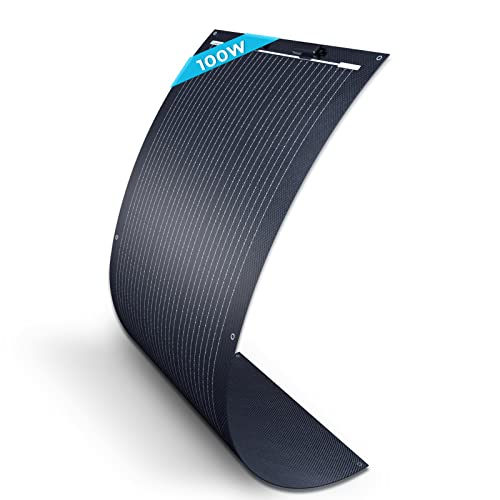
Renogy’s 100W flexible panel is ideal for curved vehicle roofs or other contoured surfaces. It delivers about 500 Wh per day under favorable sun conditions, depending on location. The panel’s ultra-lightweight design—roughly a third the weight of rigid panels—facilitates easier installation and handling. It features half-cut PERC cells to improve light capture and overall output efficiency, which is beneficial for sustaining auxiliary loads on campers, boats, and RVs without sacrificing headroom or interior space.
Renogy Flexible 100W 12V Mono Panel for Uneven Surfaces

This 100W semi-flexible panel is engineered for uneven or curved roof installations on RVs and boats. It weighs significantly less than rigid panels, making handling and mounting easier on top of standing seams or rounded corners. A slim lamination profile minimizes protrusion, helping to preserve a low-profile look on a vehicle. Prospective buyers should consider mounting hardware compatibility and bonding method to ensure the panel remains secure in varying wind conditions.
ECO-WORTHY 200W Kit with PWM Controller

This kit includes a 200W solar panel pair and a 30A PWM charge controller, aimed at RVs, campers, and off-grid vehicles. The kit emphasizes wide applicability for 12V and 24V systems, offering a practical solution for basic off-grid charging needs. The panels are built with durable aluminum framing and are designed to withstand wind and snow loads. The IP65-rated junction box supports reliable performance in varied weather, and the setup suits owners seeking a straightforward, all-in-one solar upgrade.
Callsun 100W Flexible Panel for Curved Roofs

Callsun’s 100W flexible panel is designed for curved surfaces on RVs and boats, offering up to 240° bending flexibility and a lightweight design. The front ETFE layer provides durability against UV exposure and weathering, while the panel’s ultra-thin profile (about 0.1 inches) helps with stealth installations and low wind resistance. This panel is suitable for users seeking a discreet power boost without sacrificing mounting flexibility or vehicle aerodynamics.
Buying Guide
Key purchase considerations for car roof solar panels:
- Surface compatibility: Choose panels designed for curved surfaces if you have a rounded vehicle roof, such as vans, RVs, or boats.
- Weight and thickness: Lighter and thinner panels simplify mounting and reduce roof load but ensure they still deliver sufficient wattage for your needs.
- Flexibility vs. durability: Rigid panels are robust and durable but limited by shape; flexible panels excel on curved roofs but may require careful mounting to avoid stress.
- Electrical system compatibility: Confirm whether the panel supports 12V, 24V, or both, and verify charge controller compatibility (PWM vs. MPPT).
- Weather resistance: Look for IP ratings, UV resistance, and robust frames to withstand wind, rain, and snow loads specific to your region.
- Installation method: Consider adhesive bonding, mounting rails, or brackets, ensuring that the chosen method matches your roof material and local standards.
- Future expandability: If you plan to scale up, select panels with modular compatibility and standard connectors (e.g., MC4) for easy integration.
In sum, the best choice depends on your roof type, space, and power needs. Flexible panels shine on curved surfaces and stealth setups, while rigid kits may offer straightforward, durable configurations for larger, flat sections. Assess the climate, sun exposure, and the battery bank you intend to support to pick a solution that balances efficiency, weight, and installability for your vehicle.