Best Solar Panels for a Truck Roof: Top Picks for Off-Grid RVs
Choosing the right solar panel setup for a truck roof helps maximize energy independence while riding or camping off-grid. This guide highlights five strong options that balance size, efficiency, and durability for tight roof spaces on trucks, vans, and RVs. Each product is evaluated for 12V and 24V compatibility, weight, and mounting versatility to support on-the-road power needs without compromising clearance or aerodynamics.
| Product | Brand | Power | Type |
|---|---|---|---|
| Renogy 200W N-Type (24V) | Renogy | 200W | N-Type, 24V |
| Renogy ShadowFlux 200W (12V) | Renogy | 200W | N-Type Anti-Shading |
| ECO-WORTHY 200W Kit | ECO-WORTHY | 200W | Monocrystalline 24V/12V |
| ECO-WORTHY 130W Flexible | ECO-WORTHY | 130W | Flexible Monocrystalline |
| Renogy 100W Flexible | Renogy | 100W | Flexible 12V |
Renogy 200W N-Type Solar Panel (24V)

The Renogy 200W N-Type panel is designed for compact spaces on Class B vans and truck tops. It features a smaller footprint and lighter weight while delivering 200W of clean energy. The panel uses advanced 16BB N-Type cells with about 25% efficiency, enabling higher energy conversion and better heat resilience. It is compatible with both 12V and 24V battery systems, offering installation flexibility for limited roof space and tight cargo areas.
Renogy 200W ShadowFlux Anti-Shading N-Type

Renogy’s ShadowFlux 200W panel improves performance in shade and partial sun conditions, a common scenario on vehicle roofs near trees or buildings. It employs anti-shading technology to reduce hot spots and micro-cracks, while maintaining high efficiency with 16BB N-Type cells at around 25%. The panel is slightly smaller and lighter than traditional PERC options, making it suitable for limited roof space on trucks and RVs and easy integration with 12V or 24V systems.
ECO-WORTHY 200W Solar Panel Kit

This 200W kit provides a complete off-grid charging solution with a 30A PWM charge controller. The kit is suitable for RVs, campers, vans, and boats, delivering daily output estimates around 800Wh under full sun. ECO-WORTHY panels use high-efficiency monocrystalline cells and feature a robust aluminum frame rated to withstand wind and snow loads. The kit is designed for durability and straightforward mounting on curved or flat truck roofs, supporting both 12V and 24V battery configurations.
ECO-WORTHY 130W Flexible Solar Panel

The 130W flexible panel from ECO-WORTHY is designed for curved or irregular truck roofs, boats, or RV skin. Its ultra-thin, lightweight construction uses polymer materials to reduce weight by about 70% versus traditional glass panels, simplifying installation. It delivers roughly 520Wh per day under optimal sun and can be mounted on surfaces that aren’t flat, expanding roof-mount options for truck owners seeking stealth or aerodynamic options.
Renogy 100W Flexible Solar Panel
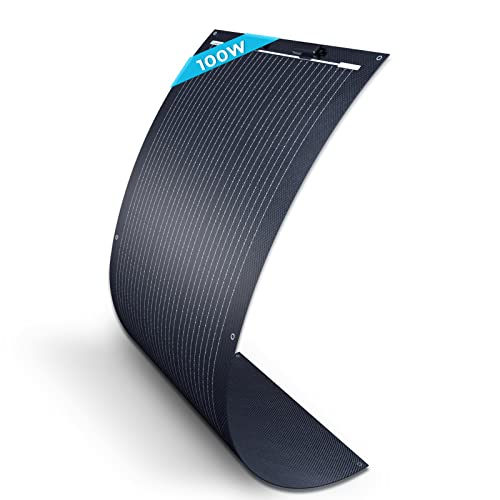
Renogy’s 100W flexible panel is designed for curved, uneven roof surfaces where rigid panels can be hard to mount. It’s 70% lighter than a rigid panel and uses semi-flexible construction for easier handling and installation on vehicles like vans or truck caps. The flexible design reduces protrusions and supports a stealthy, low-profile install while still contributing meaningful charging capacity for 12V systems and smaller 24V configurations when paired with appropriate wiring and storage.
Buying Guide: Key Considerations For Truck Roof Installations
- Power needs and system voltage: Determine your daily energy use and whether you’ll run 12V or 24V battery banks. Dual-voltage compatibility increases flexibility for upgrades or multiple devices.
- Roof space and weight: Vans and trucks have limited headroom and weight limits. Flexible panels and compact 200W units save space and reduce weight, enabling easier mounting on curved or irregular surfaces.
- Durability and weather resistance: Look for panels with robust frames, corrosion resistance, and IP-rated junction boxes. Panels designed for outdoor and mobile use typically endure vibrations and wind better.
- Shade tolerance and efficiency: Anti-shading tech and high-efficiency cells help maintain output when trees, awnings, or roof racks cast shadows during the day.
- Mounting options and flexibility: Choose panels with pre-drilled holes or low-profile mounting systems. Flexible panels are excellent for curved roofs, while rigid panels may offer easier long-term serviceability and air flow underneath.
- System integration: Consider compatibility with charge controllers (PWM vs MPPT), inverters, and battery chemistries (lead-acid, LiFePO4). Some kits include controllers for a turnkey install.
- Durability in mobile environments: Panels designed to withstand bouncing, wind forces, and potential hail or debris will better serve occasional off-road use.
- Maintenance and upgradability: Plan for future expansions, such as adding more panels or upgrading to a higher-capacity battery bank as energy needs grow.
The selections above provide options across rigid and flexible designs, with sizing that suits tight truck roofs or Class B vans. Each option emphasizes a balance of space efficiency, efficiency, and mounting versatility to support on-the-road power while avoiding excess weight or wind drag. When choosing, map your typical sun exposure, roof geometry, and battery system to optimize performance and longevity on the road.