Best Solar Panels for Airstream: Flexible, Lightweight Options for RV Roofs
Discover top solar panel picks ideal for Airstreams and other RVs. This guide focuses on flexible, lightweight, and high-efficiency panels that conform to curved roofs and tight spaces, helping you maximize daily power without adding bulk. Below are five strong options with notable features for on-the-go use.
| Product | Brand | Key Benefit |
|---|---|---|
| Renogy 100W Flexible Panel (Ultra Lightweight) | Renogy | High power output; flexible to 240°; low-profile appearance |
| Renogy 100W Flexible Panel (Semi-Flexible) | Renogy | Extremely flexible; 70% lighter; slim lamination |
| Renogy 50W Flexible Panel | Renogy | Ultra-thin, stealthy install; lightweight for curved roofs |
| ECO-WORTHY 200W Kit | ECO-WORTHY | High efficiency with PWM controller; robust frame |
| Renogy 200W Portable Foldable Panel | Renogy | 25% efficiency; portable and foldable for tight spaces |
Renogy 100W Flexible Panel — 240° Ultra Lightweight
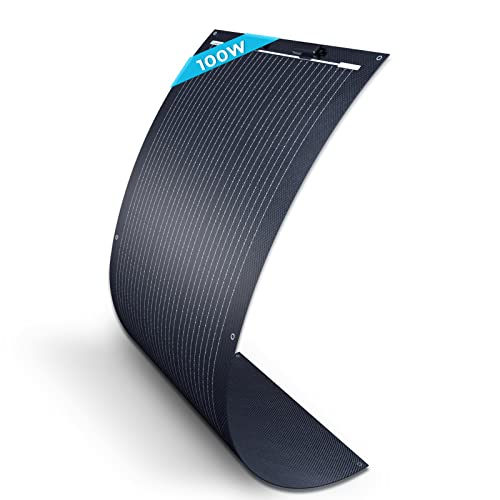
The Renogy 100W Flexible Panel is designed for curved or uneven Airstream roofs. It delivers high output with a bendable design up to 240 degrees and weighs about a third of rigid panels. Its black, glare-free appearance helps with stealth installations on shaded or reflective surfaces, while half-cut PERC cell technology boosts overall efficiency and power yield in various sun conditions.
Renogy 100W Flexible Panel — Extremely Flexible

This semi-flexible Renogy panel is engineered for applications where standard panels won’t fit, such as curved Airstream roofs. It weighs about 70% less than traditional panels, enabling easier transport and quick installation. A super thin lamination keeps the panel nearly flat, offering a discreet solar upgrade for stealthy setups.
Renogy 50W Flexible Panel — Ultra-Thin

The Renogy 50W flexible panel is suitable for smaller Airstream setups or secondary roof areas. It emphasizes extreme flexibility, light weight, and a nearly imperceptible profile. The panel’s ultra-thin lamination makes it difficult to notice once installed, supporting a stealthy solar enhancement on curved surfaces.
Renogy 200W N-Type Solar Panel

This 200W N-Type panel is compact and lighter than prior models, offering a 25% efficiency with 16BB cell technology. It’s designed for 24V systems and works well in Class B vans and similar spaces. The panel emphasizes higher energy conversion and improved performance under varying sun and temperature conditions, with compatibility for 12V and 24V systems.
ECO-WORTHY 200W Kit With PWM Controller

The ECO-WORTHY 200W solar kit pairs a high-efficiency monocrystalline panel with a 30A PWM charge controller. It is designed for RVs and other off-grid applications, offering a robust aluminum frame, weather resistance, and high daily output potential under favorable sun. The kit supports RV, caravan, and marine use with enduring durability against wind and snow loads.
Renogy 200W Portable Foldable Panel

Renogy’s 200W portable foldable panel offers industry-leading efficiency at 25% thanks to 16BB N-Type cell technology. Its portability, compact fold-out design, and MC4 output make it suitable for charging power stations or batteries in RVs and off-grid setups. The lightweight build supports quick deployment in spaces with limited mounting options, improving routine daily solar harvest.
Buying Guide: Key Purchase Considerations
- Flexibility and fit: For curved Airstream roofs, prioritize ultra-flexible panels with high bend radii and low profiles to avoid wind resistance and alignment issues.
- Weight and transport: Lighter panels enable easier handling during installation and travel. Compare weights when choosing between rigid vs. flexible options.
- Efficiency vs. area: Higher efficiency panels deliver more power in limited space, but may come at a premium. Balance panel area with expected sun exposure.
- Durability: Look for corrosion-resistant frames and IP-rated enclosures, especially for RVs exposed to marine environments, rain, and wind.
- System compatibility: Ensure the panel is compatible with your battery bank (12V vs. 24V), charge controller type (PWM vs. MPPT), and any existing power stations.
- Installation method: Consider whether you prefer glue-down, adhesive, clamps, or mounting hardware. Some panels are better suited for temporary or permanent setups.
- Temperature and sun conditions: Some panels maintain higher efficiency in heat or partial shading; assess typical travel climates to optimize placement.
- Maintenance and warranties: Check product warranties and the ease of cleaning and inspection in the field for long-term reliability.