Best Car Speaker Amplifiers for Driving Music Clarity and Power
When selecting a car amplifier, the goal is to maximize sound quality, provide enough power for your speakers, and offer flexible inputs for modern head units. The following five amplifiers are selected for their balance of power, signal handling, and versatility. Each product is designed to push speakers harder, maintain clean output, and adapt to different vehicle audio installs. Use this guide to compare options and find the best match for your car audio setup.
style=”display:none”>Summary Table of Selected Products
| Product | Brand | Approx. Power (RMS) | Channels | Inputs |
|---|---|---|---|---|
| Taramps TS 400×4 Black Car Audio Amplifier | Taramp’s | 400W RMS total (4x100W @2Ω) | 4-channel | High-level & RCA |
| DS18 SXE-1200.4/RD | DS18 | 1200W RMS total (4x60W @4Ω) | 4-channel | RCA, variable crossover |
| BOSS Audio Riot R1004 | BOSS Audio Systems | 400W Max (4x100W @2Ω) | 4-channel | Low & High level |
| Taramps TS 1200×4 | Taramp’s | 1200W RMS total (4x300W @2Ω) | 4-channel | RCA & High Level |
| Pyle PLA2378 | Pyle | 2000W total (bridgeable) | 2-channel | MOSFET, RCA |
Taramp’s TS 400×4: Versatile 4-Channel Power
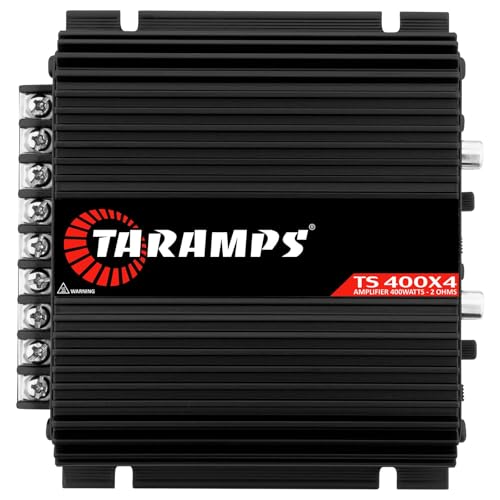
The Taramp’s TS 400×4 is a flexible 4-channel amplifier designed to drive midrange and high-frequency speakers with 100W per channel at 2 ohms, or two bridged channels at 200W on 4 ohms. It includes dual input options: high-level input with automatic activation for compatibility with factory radios, and traditional RCA inputs for aftermarket head units. A built-in crossover provides a fixed high-pass filter at 90 Hz and a low-pass filter at 90 Hz, with a full-range option and precise gain control for fine-tuning. This model suits multi-speaker setups seeking clear, balanced amplification across channels.
DS18 SXE-1200.4/RD: High-Performance Class A/B 4-Channel

The DS18 SXE-1200.4/RD delivers robust Class A/B performance with a total of 1200W RMS across four channels at 4Ω. It emphasizes high-quality audio reproduction by leveraging a fully variable crossover, adjustable gain, and a multichannel layout that supports precise tuning for each speaker pair. Its compact design makes it suitable for custom builds where space is at a premium. The SXE-1200.4 aims to balance power and control, allowing users to tailor tonal balance and dynamics to personal tastes while maintaining clarity across the frequency spectrum.
BOSS Riot R1004: Reliable 4-Channel Power
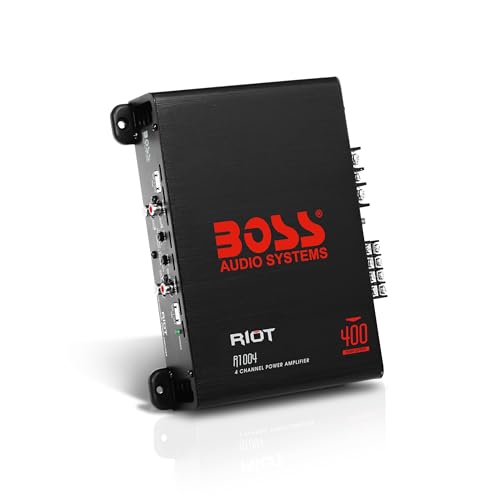
The BOSS Riot R1004 provides a practical 4-channel solution with up to 100W per channel at 2Ω or scaled for 4Ω loads. It supports both low-level RCA and high-level inputs, making it compatible with factory radios as well as aftermarket head units. The Class A/B topology typically yields strong current capability, which helps drive speaker arrays with minimal distortion at typical listening levels. This model appeals to installers seeking a straightforward, dependable four-channel amp for midrange and treble drivers in a multi-speaker setup.
Taramp’s TS 1200×4: High-Output Multichannel Power

Taramp’s TS 1200×4 is a premium multichannel amplifier rated for 1200W RMS total with four channels delivering around 300W RMS per channel at 2Ω. It supports both RCA and High Level inputs with automatic activation, enabling seamless integration with many head units and factory radios. A fixed crossover (HPF/LPF) option provides precise control over which frequencies reach each speaker, delivering clean highs and powerful mids. The TS 1200×4 is well-suited for complex installations requiring robust power distribution across multiple speakers and tweeters.
Pyle PLA2378: High-Power 2-Channel Option

The Pyle PLA2378 is a 2-channel amplifier capable of delivering up to 2000W total output in bridge mode. It features MOSFET power supply, a configurable electronic crossover, and bass boost control. RCA input/output are gold-plated to minimize signal loss, and a subsonic filter helps prevent low-end interference from muddying audio. This model is especially suitable for users aiming to power a dedicated subwoofer while also driving front channels, or for those who want to maximize output for a two-speaker setup with bridgeable operation.
Buying Guide: Key Purchase Considerations
- Power needs and speaker load: Match the amplifier’s RMS power to your speaker wattage and impedance. Four-channel amps are ideal for two front and two rear full-range speakers, while bridgable two-channel units provide options for a subwoofer pairing with front channels.
- Input compatibility: Look for models offering both high-level (speaker-level) and RCA inputs to accommodate factory radios and aftermarket head units. Automatic activation can simplify integration with non-amplified factory systems.
- Crossover controls: Fixed crossovers (HPF/LPF) help shape the frequency range sent to each speaker, preserving clarity and reducing distortion. Fully variable crossovers allow precise, speaker-specific tuning for optimized sound.
- Thermal and build quality: A robust MOSFET power supply and efficient Class A/B or Class D design minimize heat and distortion during long listening sessions. Check for solid mounting options and compact footprints for tight installations.
- Bridgeability and flexibility: If you plan subwoofer support or future upgrades, choose models with bridgeable modes and multiple input options. This provides room for expanding your system without swapping amps.
- Installation considerations: Some amps are easier to install in compact dashboards or under seats due to slim profiles. Consider ring-fader gains, sensitivity controls, and wiring harness compatibility when planning cabling runs.
- Sound signature vs. use case: Class A/B amps tend to deliver stronger dynamic range and linearity at moderate levels, while Class D designs excel in efficiency and heat management at higher powers. Your listening habits and vehicle acoustics influence the right choice.
- Budget and value: Higher-output amps with premium crossovers and inputs justify their price when you need precise tuning in a multi-speaker setup. Budget-conscious buyers can still achieve solid performance with capable, reliable four-channel options.
These considerations help balance power, control, and install practicality. For most four-speaker systems aiming at clear midrange and treble with good headroom, a 4-channel amplifier in the 400–1200W RMS total range is often sufficient. If you plan to add a subwoofer, ensure the amp supports bridge mode or select a model with a dedicated subwoofer output and appropriate crossover options. Always verify compatibility with your speakers’ impedance and your vehicle’s electrical system to avoid underperforming or overheating.