Best Car Speakers for Upgrading Your Ride’s Audio Quality
Upgrading your car’s speakers can transform your daily drive, delivering clearer vocals, deeper bass, and better overall fidelity. The following selections emphasize strong power handling, clarity, and compatibility with a variety of factory systems. Each option balances performance with ease of installation, making them suitable for DIY installs or professional upgrades. Below you’ll find five well-rounded picks, plus a practical buying guide to help you choose the best match for your vehicle and listening preferences.
| Product | Brand | Impedance | Approximate Power Handling | Notes |
|---|---|---|---|---|
| Pioneer F-Series TS-F1634R | Pioneer | 4 ohms | 200W max | 2-way coaxial, stock-replacement friendly |
| Pioneer A-Series Plus TS-A1681F | Pioneer | 4 ohms | 350W max | 4-way design, enhanced bass |
| Pioneer TS-F6935R | Pioneer | 4 ohms | 230W max | 3-way coaxial, balanced sound |
| JBL GTO939 | JBL | 4 ohms | 300W max | 3-way, versatile and loud |
| Skar Audio TX65 | Skar Audio | 4 ohms | 200W peak (100W RMS) | 2-way elite coaxial |
These selections provide a mix of single- and multi-driver configurations, designed to deliver clear highs, focused mids, and impactful bass without requiring extreme amplification. Consider your vehicle’s space, mounting depth, and wiring when evaluating models. The product pages linked below contain more detailed specs and compatibility notes.
Pioneer F-Series TS-F1634R — 6.5” 2-Way Pair

The Pioneer F-Series TS-F1634R focuses on a balanced, high-efficiency sound suitable for OEM power. With 200W max handling and an 88dB sensitivity, these 6.5″ speakers deliver clearer sound at moderate volume. The 2-way coaxial design merges a woofer and tweeter to cover a wide frequency range, helping to reproduce vocals and instruments with minimal distortion. They’re a solid stock-replacement option for many mid-tier factory systems, offering improved treble detail and overall fidelity without demanding extra power from the head unit.
Pioneer A-Series Plus TS-A1681F — 6.5” 4-Way

The TS-A1681F adopts a four-way design, providing separate drivers for different frequency bands to improve clarity across the spectrum. It handles up to 350W peak power and 80W continuous, enabling crisper highs and deeper lows compared with standard factory speakers. With a frequency response spanning 35 Hz to 29 kHz, this model suits listeners who crave broader tonal range and more precise imaging, making it a strong factory upgrade that preserves head-unit dynamics while enhancing performance.
Pioneer TS-F6935R — 6” x 9” 3-Way

The TS-F6935R expands sound staging with a 3-way coaxial design, including a dedicated tweeter and midrange alongside the woofer. With 230W max power and 87dB sensitivity, these 6″ x 9″ speakers deliver robust output without excessive distortion at higher volumes. The three-way configuration helps maintain balanced output across low, mid, and high frequencies, providing clearer vocals and smoother instrumentals for a more engaging listening experience in larger cabins or for those who prefer more dynamic range from a mid-sized speaker format.
JBL GTO939 — 6×9” 3-Way Coaxial
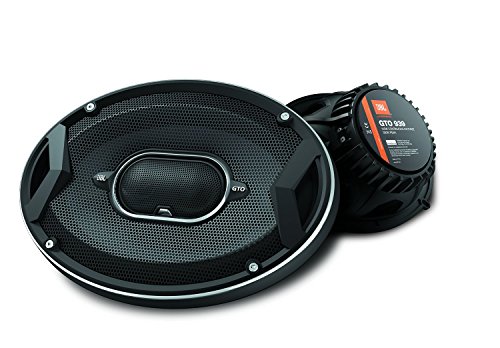
The JBL GTO939 offers a robust three-way design with a Plus One woofer cone and a flexible tweeter array, enabling easy tuning for strong, consistent output across a broad frequency range. With 300W max power and 4-ohm impedance, these speakers are designed for higher-power head units or aftermarket amplifiers. Users can expect improved midrange presence and defined highs, making them a versatile choice for listeners who want a balanced, stadium-like sound with reliable clarity at louder volumes.
Skar Audio TX65 — 6.5″ Elite Coaxial

The Skar Audio TX65 pair combines a 6.5″ woofer with a 1″ silk-dome tweeter in a high-efficiency 4-ohm design. Peak power is 200W per pair, with a practical RMS around 100W per pair, offering strong performance without requiring heavy amplification. The 4-ohm impedance supports flexible integration with most factory head units and aftermarket amps. This configuration emphasizes a clean midrange and crisp highs, making it suitable for listeners who demand solid overall balance and good vocal clarity in daily driving scenarios.
Buying Guide: Key Purchase Considerations
When selecting car speakers, consider the following factors to ensure the best match for your vehicle and listening style:
- Speaker Type: Coaxial vs. component. Coaxial speakers are easier to install and fit well with factory head units, while component systems offer superior imaging and stage depth but require more installation work and crossover configuration.
- Impedance and Power Handling: Most aftermarket 4-ohm speakers pair with common head units. Check your head unit’s rated output and ensure your amp (if used) can handle the speakers’ peak and RMS power without distortion.
- Frequency Response: A wider range translates to deeper bass and brighter highs. If you want stronger bass from 6.5″ speakers, look for models with higher low-end extension and/or additional bass-focused design elements.
- Sensitivity: Higher sensitivity (measured in dB) means louder output at the same power. If you’re upgrading on a stock system, higher sensitivity can improve perceived loudness without extra amplification.
- Mounting Depth and Size: Confirm the speaker diameter and mounting depth for your vehicle doors or panels. Some aftermarket speakers require shallow or deep mounting, adapters, or modified grilles.
- Vehicle Compatibility and Installation: Factory-fit or universal designs can simplify installation. Stock replacement options typically maintain OEM aesthetics while upgrading sound quality.
- High-Quality Components: Look for robust cones, decent surrounds, and solid grilles. Durable materials help reduce distortion and improve longevity in varying temperature conditions.
- Budget vs. Performance: While higher-end speakers offer richer sound, well-chosen mid-range models can significantly improve audio without requiring an expensive upgrade chain.
Choosing the right set depends on your vehicle’s space, your preferred music style, and how much you value bass response versus high-frequency detail. Pairing consistent speakers with a suitable head unit or amplifier often yields the most noticeable improvement in overall listening experience.