Best Tire Pressure Gauges for Racing: Precision Tools for the Track
Racing demands exact tire pressure management to optimize grip, handling, and tire life. The right tire pressure gauge provides fast, repeatable readings under track conditions. This guide reviews five top-rated gauges that blend analog clarity, digital precision, and rugged construction to stay accurate in pit lanes and garages.
| Product | Brand | Typical Range & Key Feature |
|---|---|---|
| Joes Racing 32317 Pro Tire Gauge | Joes Racing | 0-60 psi; glow-in-the-dark face; 2.5″ dial |
| Longacre 52-52003 Tire Pressure Gauge | Longacre | 2.5″ glow dial; protective bumper; high-flow release |
| QuickCar Racing 56-041 | QuickCar | Includes swivel chuck and relief valve; vehicle-specific fit cues |
| Longacre 50417 Analog Tire Gauge | Longacre | 0-60 psi; large glow dial; hose and dual chucks |
| JACO ElitePro Digital Tire Gauge | JACO Superior Products | 100 psi; ANSI 2A standard; dual sensors; 0.50% accuracy |
Joes Racing Pro Tire Gauge 0-60 PSI

The Joes Racing Pro Tire Gauge features a durable steel housing with an external rubber cushion to withstand daily pit area use. Its 0-60 psi range provides quick checks on race tires, and the 2.5-inch white-faced dial offers clear readings. With a glow-in-the-dark face option and repeatable accuracy, this gauge supports consistent pressure checks during low-light sessions or after tire warm-up. It ships in a compact form, useful for on-board tool kits and pit boxes.
Joes Racing 32307 0-60 PSI Tire Gauge

This gauge provides a glow-in-the-dark dial face for visibility in dim garages and pit lanes. It includes an air pressure release button for quick relief and a 17″ flexible hose to reach valves at awkward angles. The 0-60 psi range covers most race tires, enabling rapid adjustments during practice or pre-race prep without swapping instruments.
JOES RACING 32305 0-15 PSI Gauge

Designed for lower tire pressures, the 0-15 psi range is common for track-style tires or pre-season baseline checks. The glow-in-the-dark dial face enhances readability in low-light environments. This gauge emphasizes straightforward readings and quick checks, making it practical for paddock setups where fast turnarounds matter.
Longacre 52-52003 Tire Gauge

This model emphasizes durability and visibility with a 2.5-inch glow-in-the-dark face and a shock-resistant bumper. The high-flow air pressure release helps dial in exact pressures to prevent overinflation, while the swivel angle chuck and optional ball chuck improve access to tire valves from tight angles typical in race setups. It’s a balanced choice for frequent use in garages and on pit lanes.
QuickCar Racing 56-041 Gauge

QuickCar’s 56-041 gauge includes a swivel chuck and relief valve for controlled deflation, alongside vehicle-specific fit cues. The package’s dimensions emphasize portability for on-track adjustments. While it highlights general use, the gauge’s design aims to support rapid, repeatable readings—an essential feature for teams managing multiple tires or weather-affected sessions.
Joes Racing 32484 Quick Fill Gauge

This gauge blends a traditional analog reading with a quick-fill inflator and a glow-in-the-dark dial. Chrome angle chuck is pre-installed for easier valve access, and the quick-fill capability supports fast adjustments during pit stops. It’s well-suited for teams seeking a simple, reliable tool for frequent tire pressure checks and topping off during events.
JACO ElitePro Digital Tire Gauge
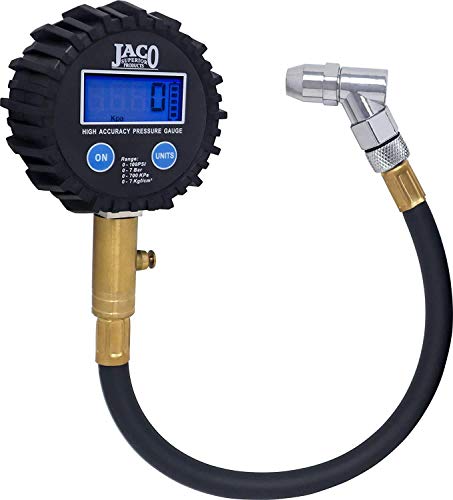
The JACO ElitePro Digital Tire Gauge delivers professional-grade accuracy with dual pressure sensors certified to ±0.50% FS, displaying readings up to 100 PSI with 0.10 PSI resolution. It includes a built-in air bleeder for real-time pressure adjustments and a robust, brass-and-steel construction with a shock-resistant guard. An extended hose and 360-degree swivel chuck enhance accessibility in crowded garages and on the track, making it a strong digital option for precision-focused teams.
Buying Guide: Key Purchase Considerations
- Pressure range: For racing, gauges that cover at least 0-60 psi (or higher) accommodate most track tires, including low-profile performance tires.
- Display type: Analog gauges offer quick, visual readings at a glance, while digital gauges provide higher precision and easier verification, especially when gripping is needed mid-session.
- Durability: Look for a metal housing and shock protection to withstand constant handling in pits and garages. A protective bumper or guard helps prevent damage from drops.
- Readability: Glow-in-the-dark faces aid use in dim lighting, but ensure the dial is large enough and numbers are clear for rapid interpretation during warm-ups or pit stops.
- Valving and chuck design: Swivel chucks and ball chucks improve accessibility to valve stems from tight or angled positions common in race cars.
- Additional features: Built-in bleed valves, quick-fill functionality, and high-flow release can speed adjustments and help prevent overinflation, which is critical on performance tires.
- Calibration and consistency: Analog gauges should be checked against a known reference, while digital units benefit from factory calibration and stability under temperature variations on the track.
- Portability and maintenance: Compact designs with simple components travel well to events; consider models with replaceable components or easy battery access for digital units.
In racing environments, the best tire pressure gauge balances readability, durability, and rapid adjustability. Depending on your setup, you may favor a glow-in-the-dark analog dial for quick checks or a digital gauge for precise measurements and bleed control. Combining a high-quality gauge with proper tire pressure management practices contributes to consistent lap times and tire longevity across sessions.