Best Trailer Equalizer Hitch Options for Safer Towing
Towing a trailer requires stable weight distribution and effective sway control. This guide highlights top trailer equalizer hitches designed to improve steering, braking, and overall control. Each option below emphasizes weight distribution with built-in sway control, helping you tow more confidently on highways and back roads alike. Explore five trusted products from reputable brands, with key features aligned to common towing needs.
| Product | Brand | Weight Rating | Key Benefit |
|---|---|---|---|
| Fastway Connect Weight Distribution Hitch | Fastway | Not specified | Easy weight-distribution adjustments; improved steering and braking |
| Equal-i-zer 4-Point Sway Control Hitch (90-00-1000) | Equal-i-zer | 10,000–16,000 lbs GTW | Maximum sway resistance with integrated 4-point control |
| CURT 17063 Round Bar WDH with Sway Control | CURT | 10,000–14,000 lbs GTW | Integrated lubrication and sway control for smooth towing |
| VEOVR Weight Distribution Hitch with Sway Control | VEVOR | Up to 1,000–6,000 lbs tongue capacity | Four-point sway control and sturdy construction |
| CURT 17500 TruTrack 4P WDH with Sway Control | CURT | Up to 10,000 lbs GTW | Active sway control with easy setup |
id=”fastway-connect”>Fastway Connect Weight Distribution Hitch

The Fastway Connect Weight Distribution Hitch uses hardened steel chains to connect hitch arms to the trailer frame, enhancing load distribution for steadier steering and braking. Adjustments are simple: change the chain link attachment to fine-tune weight distribution. Its enduring design emphasizes improved towing stability and a straightforward setup process, making it suitable for frequent campers and long-distance towing alike.
id=”equal-i-zer-1″>Equal-i-zer 4-Point Sway Control Hitch (90-00-1000)

This hitch provides a high level of sway resistance with integrated four-point sway control. It transfers tongue weight to multiple axles to stabilize towing and helps keep the tow vehicle’s front end planted on the road, improving steering and braking stability while reducing stressful driving conditions for families and their cargo.
id=”curt-17063″>CURT 17063 Round Bar Weight Distribution Hitch

CURT’s 17063 combines round bar weight distribution with integrated lubrication and a forward-facing sway control bar. Its forged steel spring bars and robust head support loads up to 14,000 lbs gross trailer weight, with a tongue weight range that suits a wide variety of trailers. The lubrication system helps maintain quiet, smooth operation over time.
id=”vevor-ward”>VEOVR Weight Distribution Hitch With Sway Control

VEOVR offers a 4-point swivel control system to limit lateral movement during towing. This kit distributes trailer weight to the vehicle and trailer axles and uses fixed brackets for stability, enhancing reversing, steering, and braking performance across various road conditions.
id=”curt-17500″>CURT 17500 TruTrack 4P Weight Distribution Hitch
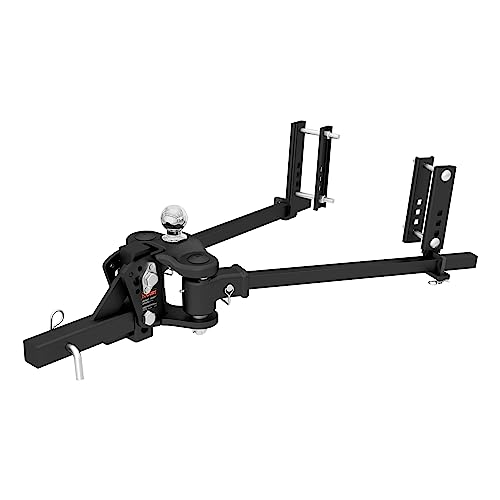
The TruTrack 4P combines active sway control with precise weight distribution. It uses a tilting head and hex castle nuts for quick adjustments without full disassembly, and provides four-point sway resistance for a smoother, safer ride across different trailer setups and road conditions.
Buying Guide: Key Purchase Considerations
- Tow capacity and tongue weight: Match the hitch to your trailer’s gross trailer weight (GTW) and tongue weight (TW). Check maximum ratings and ensure compatibility with your trailer and vehicle.
- Sway control vs. weight distribution: Some hitches emphasize sway control alone, others integrate weight distribution with sway management. For rough roads or windy conditions, active sway control adds stability.
- Shank and ball compatibility: Confirm shank size (commonly 2-inch receiver) and ball size (often 2-5/16 inch). Some models include integrated lubrication for quieter operation.
- Ease of setup and adjustments: Look for quick-adjust or tilting head designs that reduce setup time and disassembly requirements, especially for frequent campers or multi-stop trips.
- Durability and material: Coatings, forged steel components, and robust chains or brackets affect longevity in outdoor environments and under heavy loads.
- Reversing and maneuverability: Four-point sway control or swivel systems can improve turning and backing in tight spaces, reducing jackknife risk.
- Maintenance needs: Some hitches require periodic lubrication or bolt-torque checks. Plan for maintenance as part of long-term ownership.
- Compatibility with existing equipment: Ensure the chosen hitch works with your trailer coupler type and your vehicle’s hitch receiver class.