Best Transmission Jack for Semi Trucks: Heavy-Duty Lifts and Low-Profile Models
Finding the right transmission jack for semi trucks means balancing weight capacity, low-profile clearance, and maneuverability. This guide highlights five top options designed to handle large transmissions, transfer cases, and differentials with stability and ease. Each model below includes key features, load capacity, and operating details to help you compare performance in shop environments and on semi maintenance tasks.
| Product | Capacity | Key Benefit | URL |
|---|---|---|---|
| AFF Low Profile Transmission Jack (4400 lb) | 4,400 lb | Low-profile design with versatile tilt and 360° handle | https://www.amazon.com/dp/B00820LJFU?tag=atlantaspandsix-20 |
| AFF Low Profile Transmission Jack (2000 lb) | 2,000 lb | Four-way tilting saddle and 360° handle for tight spaces | https://www.amazon.com/dp/B007QV6FSC?tag=atlantaspandsix-20 |
| VEVOR Transmission Jack (1322 lb) | 1,322 lb | Extreme height range and 360° swivel saddle | https://www.amazon.com/dp/B0CLLM96VP?tag=atlantaspandsix-20 |
| Esco 2.2 Ton Transmission Jack | 4,400 lb | Wide chassis for stability and safety overload system | https://www.amazon.com/dp/B00FAC1ZP2?tag=atlantaspandsix-20 |
| Sunex Tools 1,000 lb Telescopic Jack | 1,000 lb | Dual power operation with adjustable saddle arms | https://www.amazon.com/dp/B0082LTO10?tag=atlantaspandsix-20 |
AFF Low Profile Transmission Jack (4400 lb)

AFF’s 4,400 lb transmission jack features a wishbone design that provides maximum clearance for low-profile applications. The saddle tilts and corner brackets adjust to position transmissions precisely, while the long, 32″ handle rotates 360° for versatile lifting. Four grab handles assist in mobility and setup. Strong industrial-grade casters support smooth transport, and the heavy-duty steel body handles the removal and installation of large transmissions, transfer cases, and differentials on trucks, buses, and construction equipment. In semi shop settings, it offers robust capacity with reliable maneuverability for heavy components.
AFF Low Profile Transmission Jack (2000 lb)

This AFF 2,000 lb jack emphasizes low-profile clearance with a four-way tilting saddle and adjustable brackets for precise positioning. The long handle rotates 360° around the pump to support operation from multiple angles, while the steel frame and durable casters enable stable transport. It’s suitable for heavier light- to medium-weight semi transmissions and related drivelines, offering a balance between compact footprint and lifting power in tighter shop bays or under raised semi rigs.
VEVOR Transmission Jack (1322 lb)

VEVOR’s transmission jack supports up to 1,322 pounds and offers a broad height range from 32 inches to 67 inches via a foot pedal, enabling seated or standing operation. The saddle features a tilt adjustment up to 30°, improving compatibility with various transmission shapes. The combination of a robust base and stable saddle helps maintain alignment during installation and removal tasks common in semi maintenance, while the 360° swivel wheel adds maneuverability in cluttered bays.
Esco 2.2 Ton Heavy Duty Transmission Jack

Esco’s 2.2-ton transmission jack is designed for heavy-duty work with a wide chassis for stability and a safety overload system. The universal saddle is fully adjustable, with brackets and a chain sling to secure transmissions of various shapes. This model is suited for semi trucks and similar vehicles requiring robust support during maintenance operations, reducing the risk of misalignment or slipping under load.
Sunex Tools 1,000 lb Telescopic Transmission Jack
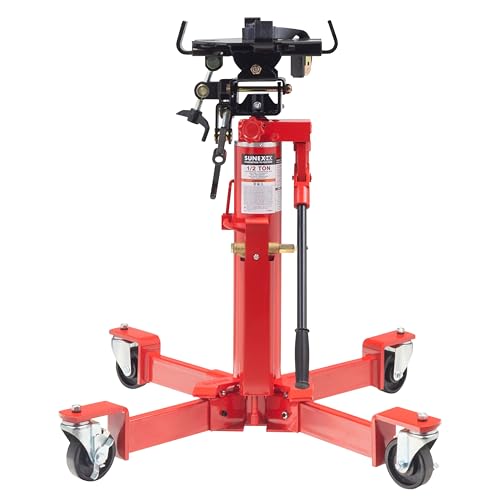
The Sunex 1,000-pound telescopic transmission jack blends dual power operation with a hydraulic lift and an air-assisted top. A foot pedal initiates the first stage, while a hand pump powers the second stage, providing flexible operation in workshop environments. Adjustable saddle arms help accommodate various pan configurations, enabling secure engagement with transmission assemblies used in heavy-duty trucks and semis, particularly in facilities prioritizing mixed power sources for lifting.
Buying Guide: Key Considerations For Choosing A Transmission Jack For Semi Trucks
Capacity and clearance are primary, but other factors determine long-term value in semi truck maintenance settings. Consider the following perspectives:
- Load capacity: Choose a model with at least 1,000 lb for standard truck segments, and prefer higher capacities (2,000–4,400 lb) for larger transmissions, transfer cases, and lifts in heavy fleets.
- Low-profile design: Essential for semi applications where undercarriage clearance is limited. A wide range of tilt and adjustable saddles helps align with odd transmission shapes.
- Saddle versatility: Four-way tilt, 30° tilt capability, and adjustable brackets improve engagement on varied transmission geometries.
- Mobility and stability: Durable casters, a stable chassis, and a wide base prevent tipping when loaded. Consider 360° rotational handles for better maneuverability in cramped bays.
- Hydraulic versus manual: Manual hydraulic jacks offer straightforward operation; some models include foot pedals or dual-power options to optimize workflow for semi maintenance tasks.
- Height range: A broad height span (e.g., 32″ to 67″ or more) accommodates different vehicle heights and service positions, reducing repetitive lifting.
- Durability: Steel bodies and quality welds extend tool life in demanding shop environments and frequent use around large vehicle fleets.
- Safety features: Look for overload protection, secure saddle locks, and robust chains or brackets to minimize slippage during installation or removal.
- Accessories and compatibility: Ensure the saddle shape and brackets support common semi transmission configurations and that any included safety chains align with your service workflow.
- Maintenance considerations: Availability of replacement parts and ease of service can affect total cost of ownership and downtime in busy shops.
In evaluating options for semi truck maintenance, prioritize models with high load capacity, wide height ranges, and adaptable saddles. This approach helps ensure reliable performance across a spectrum of transmission sizes and configurations while maintaining safety and efficiency in a professional workshop environment.