Best Weight Distribution Hitch for Travel Trailers: Stable Towing Options for Every Camper
Traveling with a loaded trailer requires reliable stability and control. A weight distribution hitch helps evenly distribute tongue weight, improves steering, and reduces trailer sway on highways and winding roads. Below you’ll find five top-rated options that balance strength, durability, and ease of use for American roads. Each product section includes an overview, key features, and installation notes to help you compare quickly.
Summary table of chosen products:
| Product | Brand | Capacity | Shank | Key Benefit |
|---|---|---|---|---|
| Integrated Sway Control Weight Distribution Kit | Reese | 11,500 lbs | Included | Preinstalled sway control and robust build |
| Round Bar Weight Distribution Hitch with Lubrication | CURT | 10,000–14,000 lbs | 2-in | Integrated lubrication and sway control |
| Fastway Connect Weight Distribution Hitch | Fastway | 2-in | Simple adjustments and solid distribution | |
| CURT Round Bar WDH with Lubrication | CURT | 8,000–10,000 lbs | 2-in | Lubrication System and sway control |
| Equal-i-zer 4-Point Sway Control Hitch | Equal-i-zer | 12,000 lbs | Standard | High sway resistance and weight distribution |
Reese 49913 Integrated Sway Control Weight Distribution Kit

The Reese 49913 kit is designed to boost stability and ride quality with a preinstalled sway control ball, tapered spring bars, and a deep drop shank. It includes all hardware for straightforward installation, including the preinstalled hitch ball and sway components. The high-strength steel head and welded hitch bar support durable performance, while powder coating enhances corrosion resistance. This setup aims to deliver reliable weight distribution across axles for improved control during highway towing, turns, and braking.
CURT 17063 Round Bar WDH with Integrated Lubrication and Sway Control
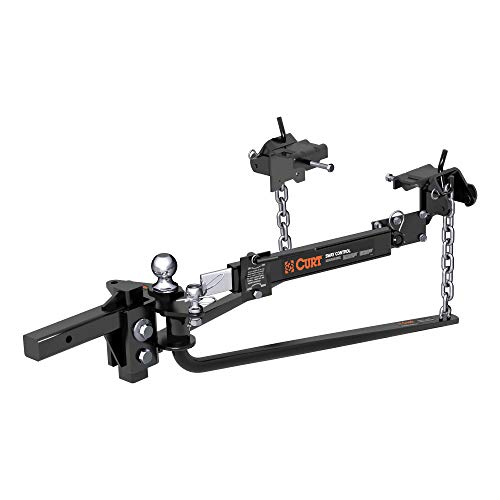
This CURT model emphasizes level towing and continuous lubrication. It distributes tongue weight across the vehicle-trailer combination and includes a sway control bar. The head accepts lubrication via two grease zerks for quiet operation, and forged steel spring bars provide robust support. Rated to tow up to 14,000 lbs gross trailer weight with a tongue weight of 1,000–1,400 lbs, it suits larger trailers and heavy loads while maintaining smooth handling.
Fastway Connect Weight Distribution Hitch

The Fastway Connect focuses on straightforward setup and adjustability. Hardened steel chains connect hitch arms to the trailer frame for improved load distribution, steering, and braking control. The system allows quick changes to weight distribution by moving the chain attachment point, providing flexibility for varying trailer loads. It is designed to enhance towing stability and is a practical option for drivers seeking reliable performance with simple adjustments.
CURT 17062 Round Bar WDH with Integrated Lubrication and Sway Control

CURT’s 17062 model offers integrated lubrication and sway control with a 2-inch shank and 2-5/16-inch ball. It uses a fabricated head and long forged steel spring bars to deliver a stable tow for trailers rated from 8,000 to 10,000 lbs gross trailer weight. The lubrication system helps keep the hitch operating quietly over time, supporting smoother steering and braking characteristics during highway driving and cornering.
Equal-i-zer 4-Point Sway Control Hitch

The Equal-i-zer hitch focuses on maximum sway resistance with a 4-point sway control system. Its weight-distribution design transfers tongue weight to all axles, helping keep the tow vehicle stable. This configuration enhances steering, braking, and overall control, especially in crosswinds or during aggressive maneuvers. It’s a strong choice for families prioritizing safety and steadiness on longer trips with sizable trailers.
Buying Guide: Key Purchase Considerations For Weight Distribution Hitches
- Weight rating and compatibility: Match the hitch to your trailer’s gross weight rating and tongue weight. Check the vehicle receiver size (commonly 2-inch) and ensure your trailer’s tongue weight falls within the hitch’s capacity.
- Sway control vs. weight distribution: Some hitches emphasize sway control, others balance both sway and weight distribution. Consider your typical towing conditions—high winds, uneven roads, or highway speeds—to decide the priority.
- Lubrication and maintenance: Integrated lubrication reduces friction and noise but requires periodic greasing. Hitches with easy-access zerks simplify maintenance. Be mindful of lubrication needs in cold climates.
- Construction and durability: Look for forged steel, welded heads, and powder-coated finishes for durability and corrosion resistance, especially if you tow in salted winter roads or coastal areas.
- Ease of installation and adjustments: Some models include preinstalled components and quick adjustment features. If you frequently switch trailers or towing setups, consider a hitch with simple, tool-light adjustments.
- Compatibility with sway control systems: If your setup includes a specific sway control design, verify compatibility (some models have integrated sway control, others rely on separate kits).
- Maintenance accessibility: Ensure grease zerk fittings and lubrication ports are accessible for regular upkeep during routine vehicle service.
- Cost vs. value: While top-tier hitches offer advanced sway control and durability, evaluate your typical towing needs and budget. A mid-range model often provides ample stability for most travel trailer setups.
To maximize safety and performance, select a weight distribution hitch that aligns with your trailer’s weight profile, towing environment, and maintenance preferences. The options listed above provide a spectrum of features—from integrated sway systems to easy adjustments—designed to keep campers confidently on the road.