Best Window Tint Meters for Accurate Solar Film and Car Window Testing
Choosing the right window tint meter is essential for verifying the legality and performance of car window tints and solar films. These advanced meters measure visible light transmittance (VLT), ultraviolet (UV) rejection, and infrared (IR) rejection to help you ensure compliance with regulations and assess product quality. Below is a summary table highlighting key features of the top window tint meters available on Amazon for convenient comparison.
| Product | Brand | Key Features | Thickness Capacity |
|---|---|---|---|
| Digital Car Window Tint Meter TM-26 | VVV-Group | VL/UV/IR Transmittance Detection, Easy Measurement, PU Case Included | Up to 8mm (1/3 inch) |
| Enforcer II Tint Meter | Laser Labs | NIST Traceable, Battery Included, Assembled in USA | Standard Automotive Windows |
| Mxmoonfree 3-in-1 Solar Film Transmission Meter | Mxmoonfree | 3-in-1 Measurement, Designed for Roll-Down Windows | Up to 8mm (1/3 inch) |
| Labs Tint Meter by GOYOJO | GOYOJO | Automatic Calibration, UV/IR/VL Detection, Data Lock | Up to 8mm |
| Digital Car Window Tint Meter TM-28 | VVV-Group | Auto Calibration, Rotatable Display, Rechargeable Battery | Up to 8mm |
Digital Car Window Tint Meter TM-26 for Accurate Light Testing

The TM-26 Meter from VVV-Group is designed for reliable measurements of light transmittance on solar films and car side windows. It detects visible light transmittance (VLT), ultraviolet (UVR), and infrared rejection (IRR) with high precision by placing the glass or film inside its slot, supporting samples up to 8mm thick. The device is ideal for professionals needing legal verification of tint levels, as well as presentations and demonstrations of tint quality. Its simple button press records results, and the included PU case adds portability for field use.
Enforcer II Tint Meter by Laser Labs with NIST Traceability

The Enforcer II from Laser Labs is built in the USA and traceable to NIST standards, assuring reliable calibration accuracy. It comes with batteries included and offers straightforward functionality for automotive tint inspection. While not specifying a thickness capacity, it is tailored for standard side windows and provides trustworthy measurements to help maintain legal compliance, favored by automotive professionals.
Mxmoonfree 3-in-1 Digital Window Tint Meter for Roll-Down Windows

This 3-in-1 tint meter by Mxmoonfree simultaneously measures visible light transmittance (VLT), UV rejection (UVR), and infrared rejection (IRR) to provide a full spectrum analysis in one reading. Designed specifically for roll-down windows, it supports glass thickness up to 8mm. Ideal for solar film production, quality control, or legal inspections, this meter offers convenience and accuracy with a digital display that facilitates quick testing.
Labs Tint Meter by GOYOJO with Automatic Calibration and Data Lock
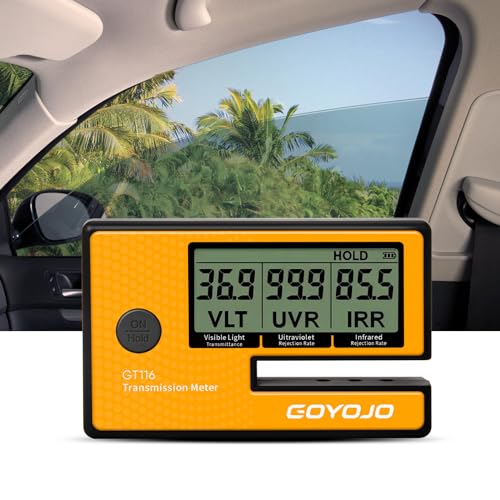
The GOYOJO Labs Tint Meter combines multiple functions—measuring UV transmission, IR transmission, and visible light transmittance—into one portable device. It supports testing up to 8mm thick films and glass, suitable for both automotive and solar applications. This meter automatically calibrates upon activation and features a data lock function for easy reading of results after measurement, enhancing efficiency during multiple tests.
Digital Car Window Tint Meter TM-28 with Rotating Display

The TM-28 from VVV-Group offers precision measurement of light transmittance, UV rejection, and IR rejection along with unique features such as an auto-rotating display for easier reading at various angles. This meter includes a rechargeable built-in battery for extended use without frequent replacements. Its capacity to test films and glass up to 8mm thick makes it suitable for professional and practical automotive tint inspections.
Buying Guide: How to Choose the Best Window Tint Meter
When selecting a window tint meter, consider these important factors to ensure the best device for your needs:
1. Measurement Parameters
The most useful meters measure visible light transmittance (VLT), ultraviolet rejection (UVR), and infrared rejection (IRR). These three metrics provide a complete picture of the window film’s performance, indicating how much light and harmful rays are blocked.
2. Thickness Capacity
Check the maximum glass or film thickness the meter can accommodate. Most high-quality meters support samples up to 8mm (1/3 inch). If your films or windows are thicker, ensure compatibility to obtain accurate results.
3. Calibration and Accuracy
Automatic calibration helps maintain device accuracy without manual adjustments. NIST traceability or certification provides confidence that the meter meets recognized accuracy standards.
4. Display Features
A clear, rotatable display or multiple display modes improve usability. Some meters offer simultaneous readings of VLT, UVR, and IRR, saving time and providing instant, comprehensive data.
5. Portability and Power Source
Consider size, weight, battery type, and whether the meter uses rechargeable batteries or standard replaceable cells. Portability is essential for on-the-go professionals.
6. Application Specificity
Some meters are designed exclusively for roll-down windows or specific industries. Ensure the meter fits your specific testing scenarios, such as automotive tint compliance or solar film quality control.
By weighing these factors, you can select a window tint meter that matches your accuracy requirements, practical usage, and budget, leading to better quality checks and legal compliance for window films.