Best Internet Boosters for Cars: Quick, Reliable Signal on the Road
Finding a strong, stable cellular signal while driving can be challenging, but the right car signal booster can make a big difference. The following picks are among the top-rated options for improving 4G LTE and 5G signals across major U.S. carriers, with FCC certification and vehicle-ready design. This guide summarizes five solid choices and highlights key capabilities to help you decide what fits your needs on commutes, road trips, or work travels.
| Product | Brand | Notable Feature |
|---|---|---|
| HiBoost Car Signal Booster | HiBoost | Precision RF connectors and enhanced heat dissipation for wider coverage |
| SureCall Fusion2Go Ultra | SureCall | High gain up to 50 dB with strong uplink power |
| Solid Signal Rover Duo OTR | Solid Signal | Two-in-one car-to-truck solution with wide carrier compatibility |
| HiBoost Car Signal Booster (Fine-Tune Max) | HiBoost | App-based gain tuning for real-time data updates |
| SIGNALPLUS External Magnetic Antenna | SIGNALPLUS | Strong magnet, wideband 698–2700 MHz for flexible mounting |
HiBoost Car Signal Booster With Enhanced Roof Antenna
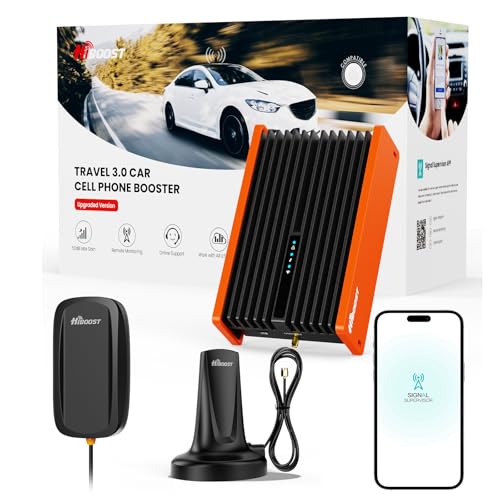
HiBoost’s precision-grade 50-ohm RF connectors reduce signal transmission loss and expand coverage compared with standard 75-ohm designs. The honeycomb briquette-inspired housing improves heat dissipation by about 30%, allowing the system to output amplified signals more quickly. The unit is compatible with all major U.S. carriers (AT&T, Verizon, T-Mobile, US Cellular) and supports 5G as well as 4G LTE, making it a versatile choice for varied networks across the country. The kit targets vehicles such as cars, SUVs, and pickups, offering a reliable upgrade for road warriors who rely on steady data and clear calls.
SureCall Fusion2Go Ultra Vehicle Signal Booster

Fusion2Go Ultra is designed to boost 5G and 4G LTE signals for cars, trucks, and SUVs, delivering dependable service even in weak signal zones. It supports multiple devices simultaneously and is FCC certified for safety and performance. With up to 50 dB of gain and uplink power up to 30 dBi, it offers strong amplification to improve calls, texts, and data usage during road trips, commutes, or remote work scenarios on the road. It’s built to keep you connected across a variety of U.S. carrier networks.
Solid Signal Rover Duo OTR 2-in-1 Booster

Rover Duo OTR offers a two-in-one solution suitable for both cars and trucks. It comes with antennas and accessories designed for easy switching between vehicle types, including cars, SUVs, vans, and semis. The system is marketed as the most powerful vehicle booster, aimed at reducing dropped calls and improving voice quality, streaming, and hotspot capability even in remote areas. It supports 4G LTE and 5G bands across all major U.S. carriers and works with multiple devices simultaneously, making it a flexible option for mixed fleets or personal use with varying vehicle needs.
HiBoost Car Signal Booster With Fine-Tune App

This HiBoost model emphasizes user-controlled tuning via a dedicated app, enabling real-time monitoring of signal changes and maximum gain adjustment. It is designed for use across all U.S. carriers—Verizon, AT&T, T-Mobile, and others—and supports 5G technology to deliver stronger cellular signals to mobile devices inside the vehicle. The app-driven fine-tuning helps optimize performance in changing driving conditions, including urban canyons and rural stretches, offering a data-informed approach to maintaining reliable connectivity on the road.
SIGNALPLUS External Magnetic Car Antenna

The SIGNALPLUS magnetic antenna is designed to firmly attach to a vehicle’s roof with a strong magnet, reducing the risk of detachment during driving. It is a wideband antenna that covers 698–2700 MHz (including 5G and 4G LTE bands) and provides up to 6 dBi of gain. The antenna is compatible with all U.S. and Canadian carriers, making it a practical upgrade for existing booster kits or standalone antenna setups to improve signal reception on the road. Its weather-resistant design helps it endure outdoor driving conditions.
Buying Guide: Key Purchase Considerations
- Coverage and gain: Higher gain models provide stronger amplification in weak-signal areas, but may require proper placement and installation to avoid interference.
- Carrier compatibility: Ensure the booster supports the networks you use (Verizon, AT&T, T-Mobile, etc.) and can handle 5G as well as 4G LTE for future-proofing.
- Vehicle type and ease of installation: Some kits are vehicle-specific (cars, SUVs, trucks) while others are universal; check included mounting hardware and mounting surfaces (roof, trunk, etc.).
- FCC certification: Look for FCC approval to ensure safety and compliance with regulatory standards.
- App-based tuning and diagnostics: Some models offer smartphone apps for real-time monitoring and gain adjustments, which can optimize performance in changing environments.
- Antenna and cabling quality: Better RF connectors, durable antennas, and weather-resistant cables improve reliability and signal integrity while driving.
- Power requirements: Verify the power options (cigarette lighter vs. integrated vehicle power) and ensure compatibility with your vehicle’s electrical system.
- Mobility needs: If you frequently switch vehicles, consider portable or two-in-one solutions designed for cars and trucks.
When evaluating options, compare real-world use cases such as highway driving versus urban canyons, and assess whether you prioritize maximum peak gain, real-time signal monitoring, or ease of installation. For fleets or multi-vehicle use, models with strong multi-user support and simple switching between vehicles can simplify management. Always verify compatibility with your primary carriers and ensure the selected kit aligns with your typical travel routes and data usage patterns.