Best HUD Projector for Cars: Top Heads-Up Displays for Safer Driving
Head-up displays (HUD) put essential driving data directly in your line of sight, reducing distraction and helping you stay focused on the road. This guide highlights top HUD projectors designed for American drivers, offering clear speed readouts, GPS directions, and alert features. Each option emphasizes ease of installation, visibility, and reliability across a range of vehicles—from compact sedans to SUVs and trucks. Explore five standout models, then compare key considerations to choose the best HUD for your car.
| Brand | Model | Key Benefit |
|---|---|---|
| KUOWEIHUD | Heads up Display for Cars | Strong GPS/BDS signals and automatic brightness |
| Pyle | PHUD19 | Plug-and-play with GPS compass |
| MAIMEIMI | Windshield Head Up Display | Large windshield projection with multi-function readouts |
| AZIJYV | M1 White HUD | Simple, glare-free white windshield display |
| SYH&AQYE | A8 5.5 | Ultra-large display with rich data |
KUOWEIHUD Heads Up Display for Cars

KUOWEIHUD’s HUD uses dual-mode GPS+BDS signals with a 10 Hz refresh rate to deliver fast, accurate speed data. It can lock onto up to 32 satellites, maintaining stable connections in urban and rural settings. An automatic brightness sensor adjusts the display for daytime and nighttime driving, reducing glare and ensuring readable readouts. The unit is USB-powered and designed for seamless installation in all vehicles with a USB port, including motorcycles and trucks. This model emphasizes reliable signal reception and adaptable visibility for safer driving.
Key features include automatic brightness adjustment, wide satellite compatibility, and universal USB compatibility. With straightforward plug-and-play setup, it aims to minimize distraction while providing essential speed, time, and driving data. The large digital font improves legibility in varying light conditions, and the device is suitable for a broad range of vehicle sizes and configurations.
Pyle Universal Vehicle Smart HUD Display PHUD19

Pyle’s 2.6-inch HUD offers plug-and-play installation near the dashboard, powered by a cigarette-lighter USB cable and engine-ignition-triggered power. The compact LCD presents speed, distance, local time, voltage, and more with clear day/night readability. A GPS compass guides routing, and the device adds automatic image balance via light sensors. This model emphasizes quick setup and practical data presentation for drivers who want a compact, informative HUD without complex configuration.
With its straightforward interface, users can quickly understand their current speed, trip data, and time. The built-in compass helps with orientation, and the automatic light-sensing features keep the display legible without being a distraction. The PHUD19 prioritizes ease of use, making it a solid option for drivers seeking a reliable, low-friction HUD experience.
MAIMEIMI Windshield Head Up Display

MAIMEIMI uses the windshield itself as a projection surface, yielding a large, easily seen speedometer readout without blocking the driver’s line of sight. It offers multiple data points, including RPM, mileage, water temperature, time, and voltage, with 16 display modes to tailor information to the driver’s needs. The HUD includes several alarm features such as speeding, fatigue driving, and voltage warnings to enhance safety during long trips.
Projected data is designed to be quick to read at a glance, with multiple data fields and an emphasis on visibility in varying light conditions. The system’s alarm suite provides proactive safety alerts, letting drivers adjust speed or take breaks as needed. MAIMEIMI’s windshield projection approach aims to reduce cognitive load while offering a richer set of vehicle metrics.
SYH&AQYE A8 5.5 Inch HUD Display
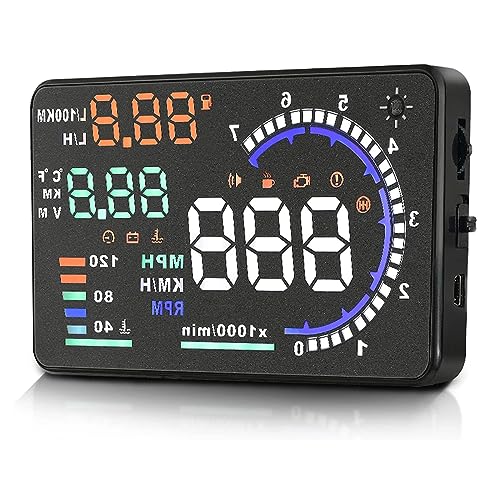
SYH&AQYE’s A8 HUD features a large 5.5-inch display with rich data presentation, including speed, engine RPM, water temperature, battery voltage, fuel consumption, and mileage. It offers auto and manual brightness control to adapt to ambient light, ensuring readability in different driving conditions. The device supports both KM/H and MPH and emphasizes multi-function display with a clear, big-screen experience for easier interpretation during quick glances on the road.
With its broad data set and large display, the A8 HUD is well-suited for drivers who want a comprehensive view of vehicle performance. Brightness automation helps maintain legibility without manual adjustments, and the dual-unit support (KM/H/MPH) adds flexibility for different markets or personal preference. It’s designed to balance information density with driver attention considerations.
AZIJYV Car Heads Up Display M1 White

AZIJYV’s M1 HUD emphasizes a simple, clean white windshield projection to minimize visual clutter. It focuses on essential data: speed, GPS compass with directional information, and driving direction, plus speeding and fatigue warnings. The design targets quick readability and straightforward installation, aiming to deliver critical information without obstructing the driver’s field of view. The unit is plug-and-play for ease of setup and use.
Key strengths include a minimalist, glare-conscious design and a clear emphasis on safety alerts. The M1 module balances essential metrics with a compact footprint, making it a practical choice for drivers who prefer a straightforward HUD that remains unobtrusive while on the road.
SYH&AQYE A8 5.5 HUD Display
SYH&AQYE’s A8 5.5 HUD provides a comprehensive set of driving data on a single, large display. It supports speed, RPM, water temperature, voltage, fuel consumption, and mileage, with auto and manual brightness controls. The device is designed to function across various conditions, offering a high-contrast readout and easy-to-interpret information. The A8 HUD additionally supports multiple data modes and color options for enhanced readability and personalization.
Buying Guide: Key Considerations For Selecting A Car HUD Projector
- Display size and readability: Larger displays can present more data but may be more visually intrusive. Look for adjustable brightness and screen modes to suit day and night driving.
- Data scope: Identify which metrics matter most to you (speed, RPM, voltage, temperature, mileage, fuel consumption) and ensure the HUD supports those readings.
- Signal reliability: GPS accuracy and multi-satellite support (GPS/BeiDou/BDS) improve speed data accuracy and reduce lag, especially in urban canyons or rural areas.
- Projection method: Windshield projection offers a clear, non-occluding readout but may require proper alignment. Some units use dashboard-mounted displays; consider your prefered viewing angle and installation capabilities.
- Power and installation: Most HUD units are plug-and-play via USB or cigarette-lighter adapters. Check compatibility with your vehicle’s power system and whether ignition-triggered power is supported.
- Alarm and safety features: Speeding alerts, fatigue warnings, and low-voltage alarms can enhance safety, especially on long trips or unfamiliar routes.
- Installation footprint: Ensure the HUD fits your vehicle model and doesn’t obstruct visibility or instruments. Consider windshield glare and mounting options included with the unit.
- Data units and customization: KM/H vs MPH, brightness auto/manual, and data field customization help tailor the HUD to your driving style and region.
When evaluating options, balance display readability with information density, reflect on the type of driving you do most (city commuting vs long highway trips), and consider whether you prefer a windshield projection or a dashboard-based readout. Reliability of satellite connections and the ease of setup are practical factors that influence daily use. The right HUD should provide essential metrics at a glance, reduce distraction, and integrate smoothly with your vehicle’s existing electrical system.