Best Automotive Electrical Tester Guide for Quick Vehicle Diagnostics
Whether you’re a DIY enthusiast or a professional technician, an automotive electrical tester helps diagnose faults fast by checking voltage, continuity, ground integrity, and component activation. This article highlights five top testers that cover 6–30V systems, include long leads, and offer modes like DC/AC voltage, resistance, and diode testing. Use these tools to locate short circuits, test relays, and verify wiring without guesswork. The table below summarizes the featured products to help you compare at a glance.
| Product | Brand | Key Features |
|---|---|---|
| Autel PowerScan Automotive Circuit Tester | Autel | 10-mode power circuit tester with long 20ft lead, activity activation of components, AC/DC voltage, resistance, duty cycle, ground check, and short-circuit finding |
| WINAMOO Automotive Test Light with 3-48V Display | WINAMOO | Digital voltage display, dual color polarity indicators, 3–48V range, quick battery load testing |
| ANCEL PB100 Automotive Power Circuit Probe | ANCEL | All-in-one 6–30V tester, extended 40ft cable, four-mode operation, component activation, short-circuit locating |
| VDIAGTOOL V500 Pro Automotive Circuit Tester | VDIAGTOOL | Multimeter/oscilloscope capabilities, open circuit location, broad test modes including fuel injector and relay tests |
| TopDiag 12 Volt Test Light Kit | TopDiag | 6–24V testing, voltage detection, component activation, diode/ground checks, short circuit tracing |
Autel PowerScan Automotive Circuit Tester

The Autel PowerScan is positioned as a comprehensive power circuit tester kit designed for vehicles with 6–30V electrical systems. It offers multiple working modes, including DC voltage, AC voltage, resistance, and a tone-on/off feature for locating signals in dim environments. The device emphasizes component activation and testing of critical automotive subsystems, such as blower motors, power windows, wipers, defrosters, lights, and fans. A notable feature is its extended cable length, combining a 20ft lead with an additional 20ft extension, plus a cigarette-lighter adapter for in-vehicle use. The kit’s ergonomic design aims to aid both novices and professionals in diagnosing electrical faults, locating shorts, and verifying grounding.
Key considerations:
- Voltage range compatibility (6–30V typical for most cars)
- Modes for voltage, resistance, and signal testing
- Independent testing of grounds and short-circuit tracing
- Component activation capability for real-world functional checks
- Cable length for access to hard-to-reach circuits
Ideal for repair shops and hands-on hobbyists who need a versatile, all-in-one tester with robust activation capabilities and long reach.
WINAMOO Automotive Test Light with 3-48V LED Display

The WINAMOO test light combines a bright digital voltage display with polarity indication, suitable for car, truck, SUV, and boat electrical systems. With a 3–48V testing range, the device supports quick battery tests and alternator checks, helping identify charging and electrical issues across a variety of circuits, including headlights, taillights, and signal circuits. The probe features a sharp stainless steel tip for accessing tight spaces and a protective sleeve to prevent accidental injury or tip loss during storage.
Key considerations:
- Clear digital readout with 0.1V resolution
- Polarity indicators simplify diagnosis in dim areas
- Sharp probe and protective sleeve for safety and reach
- Versatile use across automotive and marine electrical systems
Best used for quick voltage verification and locating faulty sockets or harness connections, especially when working in tight engine bays or cramped compartments.
ANCEL PB100 Automotive Power Circuit Probe

The ANCEL PB100 is a versatile all-in-one tester aimed at diagnosing 6–30V automotive electrical systems. It features voltage and polarity checks, continuity testing, signal verification, component activation, ground fault detection, and short-circuit locating with built-in circuit breaker protection. Its extended 20ft lead plus an extra 20ft extension, plus a cigarette-lighter adapter, provide flexibility for working around large vehicles and garage layouts. The device is described as suitable for beginners and experienced technicians alike, delivering efficient electrical troubleshooting in a single tool.
Key considerations:
- Four-mode operation covering essential electrical tests
- Long leads for around-vehicle diagnostics
- Component activation to test real-world function
- Built-in protection to safeguard against shorts during testing
Combines convenience and capability in a single, durable tester that reduces the need for multiple separate tools.
VDIAGTOOL V500 Pro Automotive Circuit Tester

The V500 Pro consolidates multiple functions into one device, including oscilloscope mode, testing for open circuits, and a broad range of voltage, resistance, and polarity checks. It emphasizes an all-in-one approach with features like relay and injector testing, plus the ability to trace wires and identify circuit issues without extensive teardown. Its comprehensive feature set makes it suitable for diagnosing modern vehicles with complex electrical architectures and multiple control modules.
Key considerations:
- Oscilloscope capability for visualizing signals
- Extensive test modes including fuel injector and relay testing
- Wire tracing and open-circuit location
- Multi-function approach reduces need for separate meters
Best for users who need advanced signal analysis in addition to standard circuit testing, especially when chasing intermittent faults or sensor-driven issues.
TopDiag 12 Volt Test Light Kit
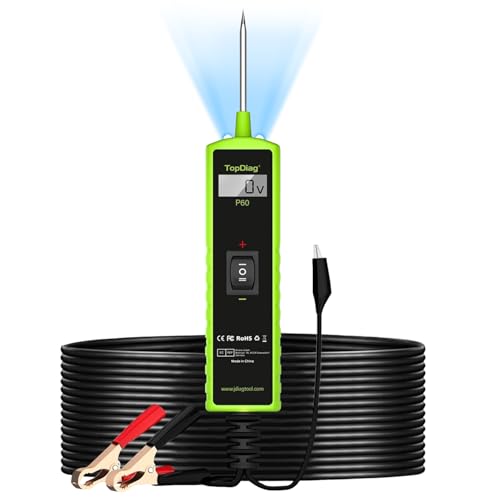
The TopDiag P60 tester focuses on automotive circuit detection with a simplified 6–24V range. It emphasizes voltage detection, component activation, diode and ground checks, and short-circuit tracing. The tester aids quick diagnostics by confirming the presence of current in a circuit and helping locate the source of faults, particularly when wiring harness integrity or relay operation is suspect. The compact design makes it a practical add-on tool for in-vehicle diagnostics and on-the-spot testing.
Key considerations:
- Compact, dedicated testing for 6–24V circuits
- Component activation and short tracing capabilities
- Diode and ground checks for quick fault isolation
Suitable for technicians who want a focused, portable tester to complement a broader electrical toolkit.
Buying Guide: Key Purchase Considerations
When selecting an automotive electrical tester, consider how you will use the tool across different vehicle makes and models. Here are the main factors to evaluate:
- Voltage range compatibility: Most cars operate within 6–24V, while some systems require 12–24V or up to 30V. Ensure the tester covers your typical use cases.
- Test modes: Look for DC/AC voltage, resistance/continuity, diode checks, polarity indications, and component activation. More modes can reduce the need for separate devices.
- Open/short circuit locating: A tester with a breaker finder or wire tracing feature saves time locating faults in wiring harnesses.
- Component activation: The ability to activate relays, motors, or solenoids in-vehicle helps confirm functional issues without external loads.
- Cable length and flexibility: Long leads improve reach in large vehicles. A cigarette-lighter adapter is helpful for in-vehicle testing.
- Safety and durability: Ergonomic design, protective sleeves, and robust construction reduce the risk of shorts or tool damage during use in tight engine bays.
- User level: Some tools are beginner-friendly with guided modes, while others cater to professionals with oscilloscope capabilities and advanced signal analysis.
Comparison at a glance:
- All-in-one capability: Most models offer multiple test modes and component activation to streamline diagnostics.
- Cable configurations: Tools with long leads (20–40 ft) and extra extension options allow better access around vehicles.
- Display clarity: Digital readouts with 0.1V resolution help precise voltage measurements in variable lighting.
- Target users: Beginners benefit from straightforward modes and guided testing, while experienced technicians may prefer oscilloscope features and deeper signal analysis.
Bottom line: Choose a tester that matches your typical vehicle types, preferred workflow, and whether you need advanced signal analysis or simple, quick checks. For a balanced setup, consider a model with multiple modes, long leads, and component activation to cover most diagnostic scenarios.