Best Plug-in Car Power Inverters for on-the-Go Charging
From road trips to daily commutes, having reliable power in the car is essential. This guide reviews five top plug-in car power inverters that convert 12V DC to 110V AC, plus USB-C and USB-A options for fast device charging. Each pick balances power, portability, and safety to keep laptops, tablets, phones, and other devices ready wherever the road takes you.
| Product | Brand | Key Feature |
|---|---|---|
| BESTEK Power Inverter DC 12V to AC 110V | BESTEK | 300W continuous, 700W peak, dual USB, compact aluminum housing |
| PiSFAU 200W Car Power Inverter | PiSFAU | 2 AC outlets, 4 USB ports, USB-C 20W, quiet operation |
| FOVAL 150W Car Power Inverter | FOVAL | 3.1A dual USB, 1 AC outlet, compact with aluminum shell |
| PiSFAU 150W Power Inverter | PiSFAU | 150W continuous, 2 USB ports, smart safety features |
| Ampeak 150W Car Power Inverter | Ampeak | 2 USB ports, 11-safety protections, compact design |
The products below are organized to help you compare power output, USB charging options, safety features, and portability—so you can pick the best inverter for your vehicle and devices.
BESTEK Power Inverter 300W With Dual USB Ports
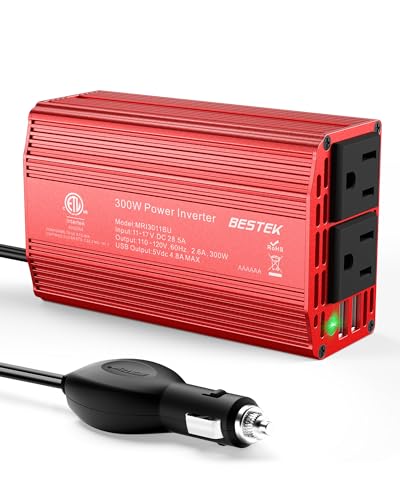
The BESTEK inverter is a patent-backed option designed for reliability and broad compatibility. It supplies 300 Watts of continuous DC-to-AC power and up to 700 Watts instantaneous power. With two standard 110V outlets and two 4.8A USB ports, it supports larger devices such as laptops and tablets while charging smaller devices quickly. Its aluminum housing emphasizes durability and heat dissipation in a compact, vehicle-friendly form. An ideal choice for road trips, commuting, and camping where multiple devices need simultaneous charging.
PiSFAU 200W Car Power Inverter with USB-C

This PiSFAU model delivers 200W continuous power via two AC outlets and four USB ports, including a USB-C port for newer devices. It emphasizes quiet operation and efficient heat management, helping prevent overheating on longer drives. Its compact, lightweight design makes it easy to store in a glove box or behind a seat, while still providing enough charging options for laptops, tablets, phones, and small appliances on the road.
FOVAL 150W Car Power Inverter
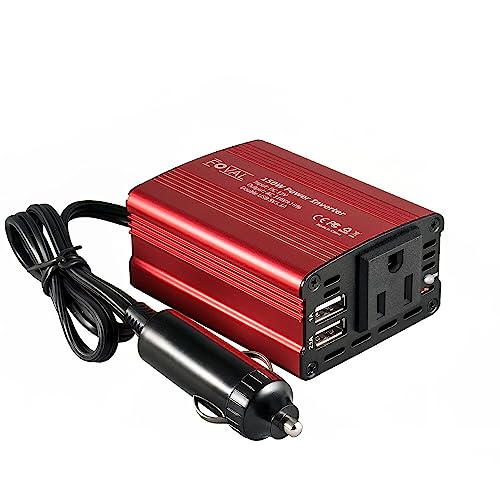
The FOVAL 150W inverter offers a compact, credit-card-sized footprint with a 1 AC outlet and dual USB ports delivering up to 3.1A combined. Its aluminum shell lends durability, and the device is designed to be portable for road trips and everyday commutes. It’s suitable for charging laptops and tablets while providing enough USB power for phones, cameras, or small gadgets during travel.
PiSFAU 150W Power Inverter With USB Ports

This 150W inverter from PiSFAU provides a solid mix of power and protection. It includes two USB ports for quick device charging and a 110V AC outlet for mid-size electronics. A smart safety system with a built-in fuse minimizes risk during faults, and the compact design makes it easy to keep in the car for spontaneous work sessions or entertainment on the road.
Ampeak 150W Car Power Inverter

The Ampeak inverter focuses on safety and efficiency with 4.8A total USB charging capability and an 11-layer protection system. Its compact profile accommodates USB charging for phones and tablets while powering a laptop or small appliance through the AC outlet. The device prioritizes protecting vehicle electronics with thoughtful surge and temperature safeguards, suitable for varied road conditions and usage scenarios.
Buying Guide
- Power output: Choose an inverter with continuous wattage that meets your device needs (laptops require more power than phones). If you plan to run multiple devices, look for higher continuous wattage and multiple USB ports.
- Number and type of outlets: Consider the mix of AC outlets and USB ports (including USB-C) to ensure compatibility with your devices and charging speeds.
- Safety features: Look for built-in protections like short-circuit, over-voltage, over-current, low-voltage, over-temperature, and auto-shutoff to protect both the inverter and vehicle electronics.
- Heat management: Inverters generate heat; models with smart cooling fans or robust heat sinking help maintain performance during longer uses.
- Size and weight: For frequent travelers, a compact and lightweight unit improves portability and storage options without sacrificing power.
- Noise and interference: Some units operate quietly, while others may produce audible fan noise under load. If you drive in quiet environments, consider low-noise designs.
- Durability: Aluminum housings and rugged construction improve durability in vehicles with vibrations or outdoor use.
- Compatibility with devices: Ensure the inverter provides stable output (true sine wave vs. modified sine wave) if powering sensitive electronics like CPAP machines or specialized medical devices. Most consumer devices work with modified sine wave, but verify if exact waveform is required.
- Portability and storage: A compact form factor helps keep the inverter easily accessible yet unobtrusive when not in use.
- Value and warranty: Compare warranties and brand reputation, especially for frequent road users or commercial vehicle operators.